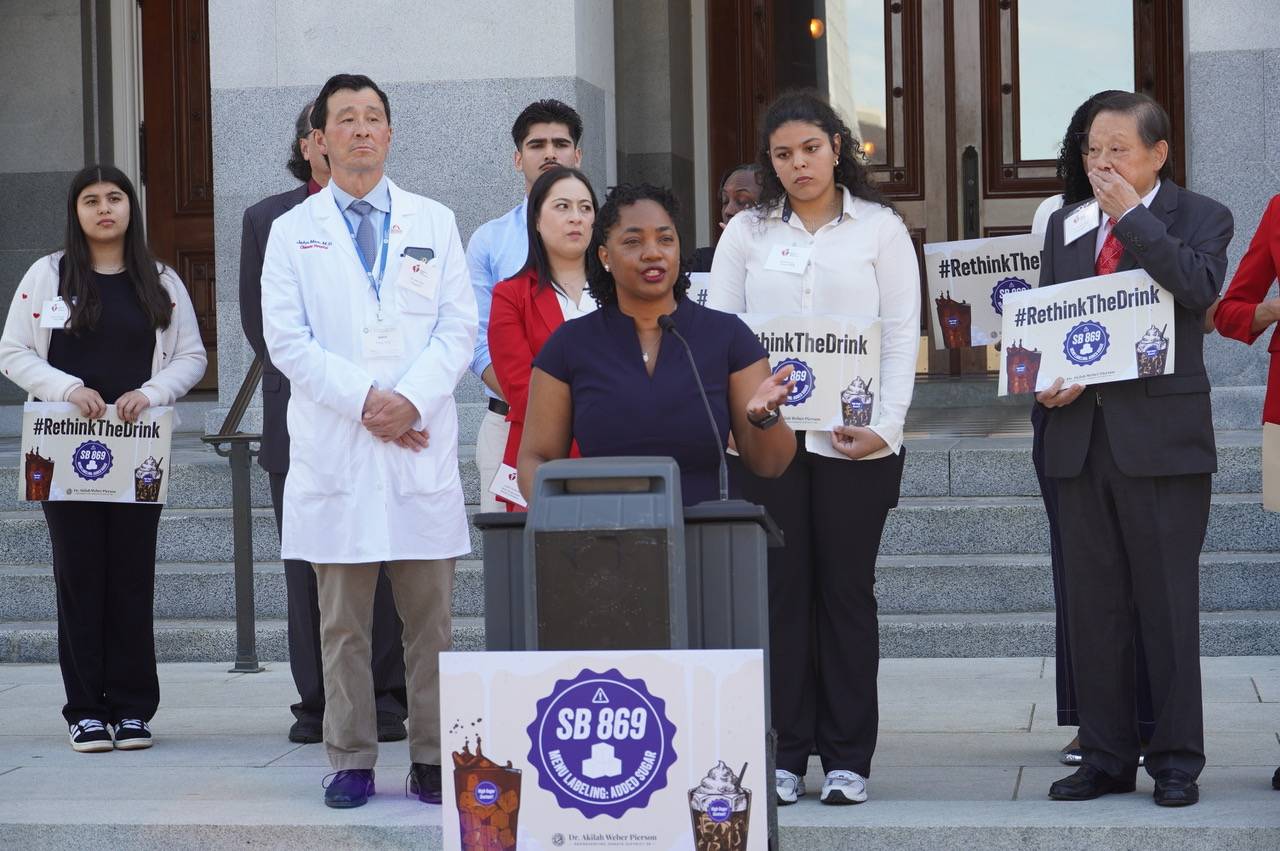
Sen. Akilah Weber Pierson’s bill, SB 869, would require chain restaurants to label beverages containing high levels of added sugar — defined as 50% or more of the recommended daily amount — on their menus. If passed, chain restaurants with 20 or more locations would be required to place a warning icon on menus beginning Jan. 1, 2028. CBM photo by Antonio Ray Harvey.
On April 8, Sen. Akilah Weber Pierson (D-San Diego) introduced a public health bill that would require chain restaurants to include warning labels on their menus for beverages with high sugar content.
Senate Bill (SB) 869 requires chain restaurants with 20-plus locations to display a specific, visible “factual warning statement” for beverages containing 50% or more of the recommended daily added sugar limit.
“This information will be placed where it matters most, directly on menus, right at the point of selection, whether printed, digital, or at drive-thrus,” said Weber-Pierson, chair of the California Legislative Black Caucus (CLBC) at a news briefing at the State Capitol.
“SB 869 does not ban products, and it does not limit consumers’ choices. What it does is empower consumers with knowledge to make informed decisions,” Weber added.
On April 9, the bill passed out of the Senate Health Committee with a 9-0 vote and was referred to the Senate Appropriations Committee. The legislation aims to combat health issues such as obesity, Type 2 diabetes, and heart disease by providing customers with clear information to make healthier choices.
Weber Pierson made the announcement at a news conference at the State Capitol that coincided with the American Heart Association’s Advocacy Day. Over 400 physicians, residents, and students gathered to meet with lawmakers to discuss patient access, practice sustainability, and other key healthcare issues.
According to the bill’s language, the specification applies to standard menu items but excludes customized customer orders, alcoholic beverages, and temporarily offered items available for less than 60 days.
The warnings, Weber Pierson added, include a designated icon and a statement at the point of selection, with exemptions for items like alcoholic beverages or customer-modified drinks.
The goal, the medical doctor from San Diego said, is to increase awareness of “obscured” sugar, with studies showing these labels influence consumers to order healthier options.
“As a physician, I know firsthand that added sugar can lead to obesity, Type II diabetes, heart diseases, and other chronic illnesses that are affecting our communities,” Weber Pierson said. “Sugar drinks are one of the largest sources of added sugar in the American diet, and many people just simply don’t know how much sugar is in what they drink.”
The California Restaurant Association and proprietors are reportedly pushing back against the legislation. Restaurant leaders oppose the measure, stating that SB 869 would be financially burdensome, leaving them no choice but to pass associated costs to consumers.
“Menu labeling mandates of all kinds add tremendous cost, and there is simply no choice but to pass those costs onto guests,” the California Restaurant Association said in a statement.
At the news briefing, Weber Pierson performed several demonstrations with collegiate and high school students in front of the State Capitol to show the high sugar content in common beverages to build support for SB 869.
The primary goal of these demonstrations was to highlight how much sugar people unknowingly consume and to promote the bill’s requirement for chain restaurants to clearly label drinks containing over 25 grams of added sugar, which accounts for 50% of the recommended daily limit.
The United States Food and Drug Administration (FDA) does not require restaurants to show sugar content directly on their printed menus. While menu boards at covered establishments must display calories for each item, they are only required to provide detailed sugar content as part of additional written nutrition information available to customers upon request, according to the FDA.
SB 869 is similar to the legislation implemented in New York City. It is the first U.S. city to require chain restaurants to place warning symbols on items with over 50 grams of added sugar, aiming to curb diseases like obesity, diabetes, and heart disease.
“People don’t need perfection handed to them—they need honesty and transparency,” said Christine Fallabel, director of Government Affairs for the American Diabetes Association. “Transparency isn’t about restriction, it’s about respect. And respect is what turns small, informed choices into lasting, healthier lives.”
While the FDA requires large chain restaurants to make some nutrition information available in restaurants, there is currently no requirement for added sugar to be publicly disclosed for restaurant foods, researchers said.
According to a report by the University of California, Davis (UC Davis), researchers discovered that warning labels reduced the probability of ordering a high-added-sugar item by 2.2%. However, only 21% of the consumers exposed to the added-sugar warning labels noticed them.
Sarah Bocter, a student from San Francisco’s Galileo Academy of Science and Technology who aspires to be a cardiologist, was one of the speakers at the news conference.
Bocter, a student volunteer for the American Heart Association, said she “hangs out with friends who like to order fun drinks and smoothies,” but sometimes they are not aware of the beverages’ content. She supports Weber-Pierson’s bill.
“Clear icons on menus level the playing field so everyone has access to the same information,” Bocter said. “I would also like to clarify that SB 869 doesn’t tell anyone what to drink. It’s a simple, common-sense step that respects personal choice while improving transparency.”
The proposal would amend the California Retail Food Code. Often called “CalCode,” it is a comprehensive set of laws within the California Health and Safety Code that sets uniform health, sanitation, and safety standards for all retail food facilities, including restaurants, markets, and food vendors.
Because the SB 869 expands the scope of existing crimes within the Retail Food Code, failure to display required sugar warnings would be punishable and classified as a misdemeanor.
Weber Pierson told California Black Media (CBM) that local health officials would be responsible for enforcing the new duties as part of a state-mandated local program. The bill does not apply to “mom and pop shops,” she said.
“We don’t want to place any undue burden on those shops,” Weber-Pierson told CBM. “That is why we are focusing on ‘large-chain restaurants,’ defined as 20 or more restaurants.”