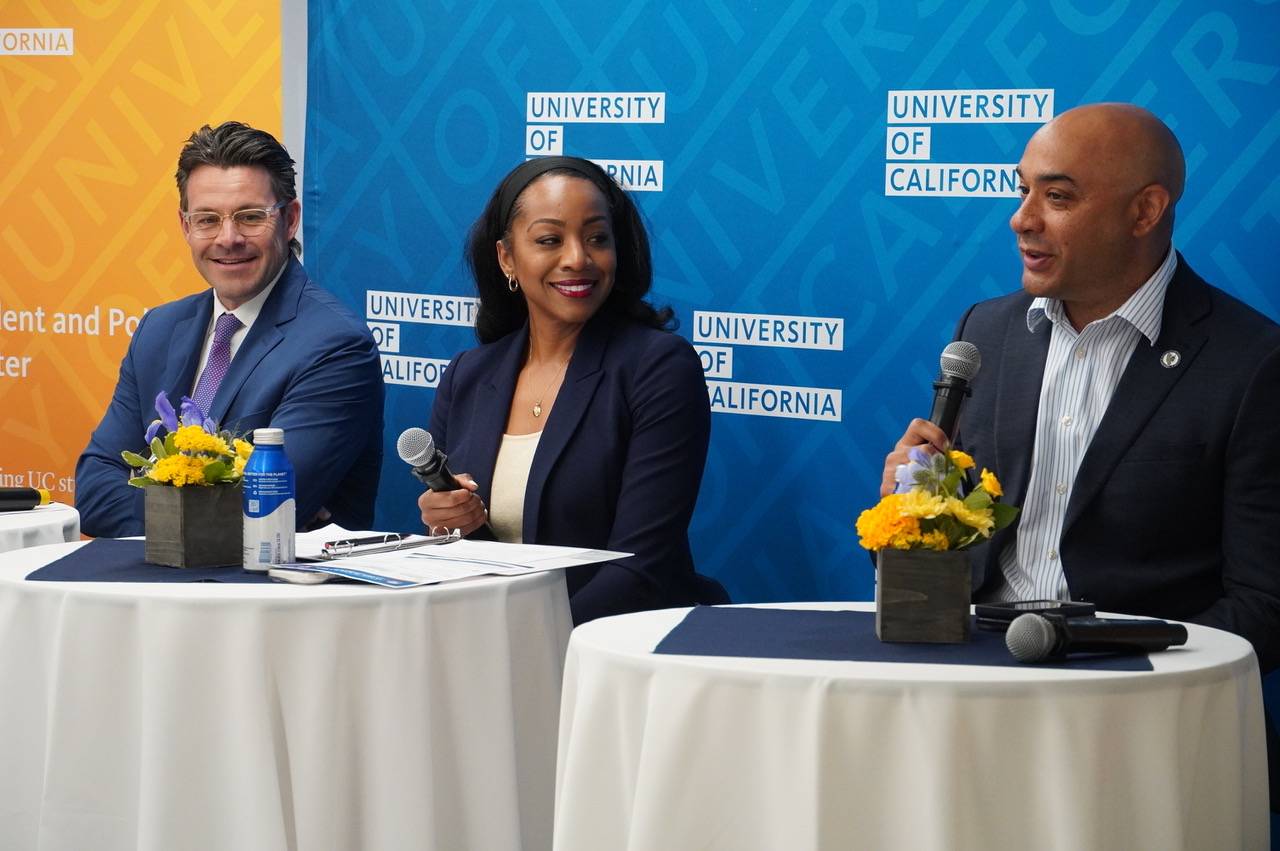
From left, Gabriel Petek, legislative analyst for the Legislative Analyst’s Office; Malia Cohen, California state controller; and Joe Stephenshaw, director of the California Department of Finance, participate in the 3rd Annual California Economic Forum in Sacramento. The panel discussion focused on California’s economic outlook, upcoming fiscal policy challenges and the state’s overall financial condition. CBM photo by Antonio Ray Harvey.
A week before the California Legislature was required to pass a balanced budget on June 15, and send it to Gov. Gavin Newsom, State Controller Malia M. Cohen urged lawmakers to exercise fiscal discipline to guard against ups and downs in state revenue and the risk of future budget shortfalls.
Speaking at the UC Student and Policy Center’s California Economic Forum in Sacramento on June 9, Cohen pointed to the state’s 2024-25 Annual Comprehensive Financial Report (ACFR) as an essential tool for understanding California’s true fiscal condition.
The ACFR is the state’s official audited financial statement, providing a comprehensive snapshot of California’s finances based on actual revenues, expenditures, assets and liabilities.
Cohen noted that this year’s report marked the first time since 2019 that California received an unmodified auditor’s opinion and completed the report before the release of the governor’s May Revision budget proposal.
“Revenues are high, higher than expected. Expenditures are also higher than expected, but we are in a structural deficit,” Cohen said. “We do need to make some changes; otherwise, the (California) government we all know and love will no longer be able to sustain.”
According to the ACFR, California reported $595.5 billion in revenue and $582.5 billion in expenditures during the 2024-25 fiscal year, resulting in a statewide surplus of approximately $13 billion.
Cohen said the report serves as a critical accountability tool during budget negotiations because it relies on audited financial data rather than projections.
The controller also addressed California’s economic outlook in the wake of the latest UCLA Anderson Forecast, the quarterly economic outlook produced by economists at the UCLA Anderson School of Management. The forecast provides analysis of economic trends affecting California and the nation, including employment, inflation and economic growth.
Cohen highlighted concerns about the state’s dependence on high-income taxpayers, the sustainability of stronger-than-expected tax revenues and the risk that short-term financial fluctuations could worsen long-term budget challenges.
She also cautioned lawmakers against relying too heavily on internal borrowing to manage deficits, urging them to limit borrowing and preserve reserve funds.
“ACFR is important to the fiscal health and wellness of the state of California,” Cohen said. “Think about how it impacts our bond rating. Think about the bond rating as your personal credit score.”
Cohen added, “For us to be creditworthy, for people to loan us money, borrow money to balance out our debts, we need (ACFR) to be out on time and to be clean.”
The third annual California Economic Forum, organized by the UC Student and Policy Center in partnership with POLITICO, brought together economists and policymakers to discuss California’s economic trajectory and the fiscal challenges facing the state.
Cohen participated in a panel discussion alongside California Department of Finance Director Joe Stephenshaw and Legislative Analyst Gabriel Petek of the nonpartisan Legislative Analyst’s Office (LAO), the Legislature’s independent, fiscal and policy advisor.
Petek said timely completion of the ACFR is critical because it provides policymakers, investors and bond markets with an accurate picture of the state’s finances before major budget decisions are finalized.
“The lack of that information and analysis could have the effect of costing more interest on the debt when (states) go to the bond markets to borrow,” Petek said. “I think it’s a notable and important thing that the state (of California) has achieved in the document.”
Stephenshaw, Newsom’s chief fiscal policy adviser, said Cohen made completion of the ACFR a priority shortly after taking office.
While the Controller’s Office compiles the report, state departments must reconcile their financial records with year-end figures submitted to the Department of Finance.
“The controller made this a priority when she took over. She met with me and expressed that task,” Stephenshaw said. “I have to commend her for the work that was done over the last couple of years to have a timely reporting of our financial statement.”
As controller, Cohen’s constitutional responsibilities center on cash management, accounting and fiscal oversight. Her office issues monthly cash reports detailing actual General Fund revenues and expenditures, providing lawmakers with up-to-date information on the state’s fiscal position.
California’s fiscal year begins July 1. The governor must sign a final budget by June 30 to ensure the state can continue funding operations, employee salaries and vendor payments without interruption.
Cohen said the ACFR gives lawmakers and the public a clearer understanding of California’s financial reality by grounding budget discussions in audited data rather than assumptions.
“ACFR should be a household name so that everybody knows about it,” Cohen said.