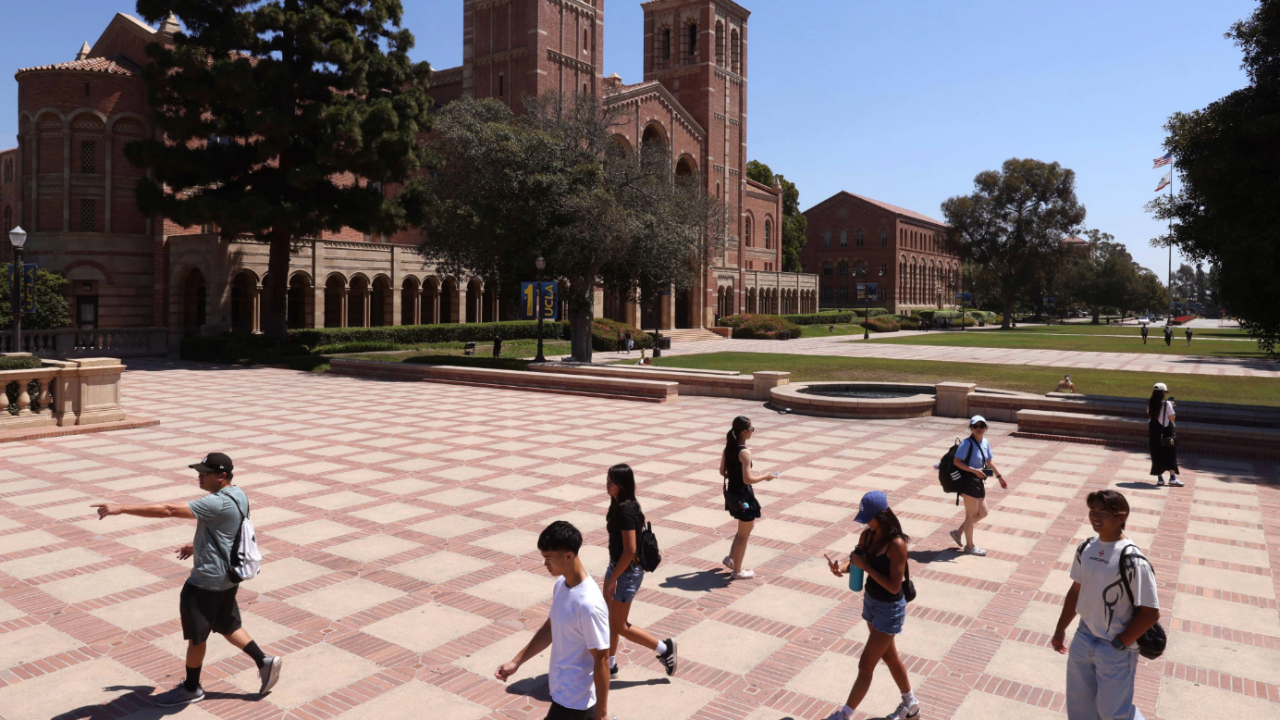
Visitors walk through Dickson Plaza against a backdrop of Royce Hall on the UCLA campus in Westwood on August 7, 2025. (Genaro Molina/Los Angeles Times via Getty Images)
Across the country, a refrain is growing: college isn’t worth it. It appears in headlines, fuels political debate, and is reshaping people’s views on higher education. Today, nearly two-thirds of Americans question the value of a four-year degree.
And yet the loudest voices pushing that argument are typically college graduates who expect their children to pursue a degree. In fact, they pull out every stop: They hire tutors, pay for test prep and enrichment, and leverage every relationship and resource to secure access to top universities.
But when the conversation turns to other people’s children, the calculus shifts.
Most who argue for college alternatives are well-meaning, with sincere concerns about debt and an evolving labor market. But good intentions don’t determine outcomes. And the students receiving this message—Black, Latino, low-income, and rural—have the most to lose.
For decades, students in these communities have been steered away from rigorous academics into programs that promised practical skills but offered limited opportunity. The rhetoric was about options. The reality was about ceilings. Students deserve an honest account of what different pathways deliver.
And, on that, the evidence is clear: college remains the most reliable path to economic and social mobility.
College graduates earn $32,000 more annually than non-grads — more than $1 million over a lifetime. They also live about nine years longer, gain greater access to professional networks, and can better navigate economic downturns.
AI is transforming the labor market and raising real concerns about the future of work. But the skills a quality college education builds—critical thinking, communication, and problem-solving — are exactly what an AI-driven economy demands. Colleges are better positioned to respond to the changing landscape than narrow credential programs, and we are already seeing many act to update curricula and integrate AI literacy.
Meanwhile, career and technical education pathways are being promoted with confidence that the evidence doesn’t warrant.
Career and technical education program quality is uneven at best — a recent study found that only one in eight credential programs leads to material wage gains. Outcomes data are scarce, leaving families without the information needed to make sound decisions. Where strong programs exist, demand often outstrips availability, making admission as competitive as some selective colleges. And career and technical education is not the cost-free alternative it is sometimes perceived to be — programs carry tuition and sometimes require students to purchase expensive equipment.
None of this is an argument for defending the status quo. Real change is needed—starting in K–12. Every student should graduate with rigorous academic preparation that makes college a genuine option. They also need structured guidance to navigate their next steps after high school.
With a national average caseload of roughly 372 students per counselor, too many young people lack the guidance they need to build strategic and balanced college lists, understand how to distinguish net costs from sticker prices and make informed decisions that set them up for success. Expanding access to high-quality advising would help ensure more students choose colleges that will challenge and support them through graduation — a result we see in schools that prioritize sustained, personalized counseling.
Higher education must change as well.
Too many colleges define their prestige based on whom they exclude rather than the opportunities they create. Admissions policies that advantage students who can pay full price or who have legacy status should be eliminated, and early decision policies should not simply reward wealth and insider knowledge. Colleges must also expand access to majors leading to the most lucrative careers.
While costs are legitimately daunting, net tuition has trended down over the past decade. But most families don’t know that—and that information gap is a barrier. Colleges should make the real cost of attendance transparent and easy to understand.
Ultimately, colleges must be accountable for supporting students through graduation and into competitive careers—ensuring degrees translate into economic security and fulfilling lives. All institutions, including career and technical, should report completion rates and earnings outcomes.
Consider Ca’Mya Felder, an Atlanta student who initially questioned whether college was a good fit and leaned toward a trade or military pathway. After meeting with advisors, participating in a summer program, and touring schools, she gained confidence and began envisioning herself on campus. She ultimately enrolled at Talladega College, received a scholarship and quickly settled into campus life. In her first semester, she made the Dean’s List.
College is not perfect. Reform is necessary. But those are arguments for fixing what is broken, not lowering expectations or pretending all paths are equal.
When influential people question whether college is meant for everyone, students like Felder absorb those messages. They instead deserve genuine belief in their potential and meaningful support to realize it. When that happens, the question stops being, “Is college worth it?” and becomes “How do we make sure more students can benefit?”
About the Author:
Shavar Jeffries is CEO of KIPP Foundation. He is a first-generation college graduate.