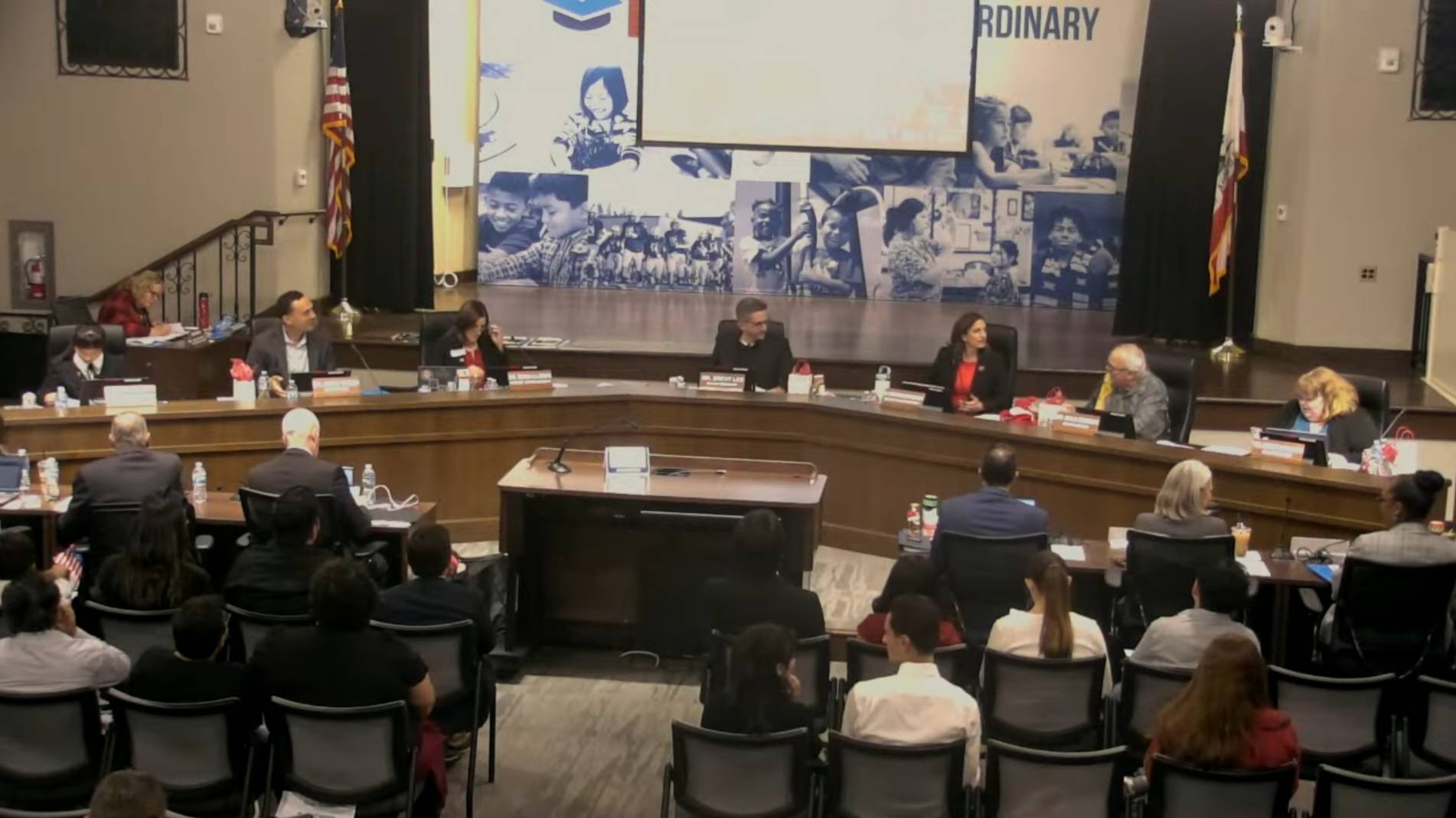
Screenshot of the Riverside School Board meeting held on December 18, 2025.
Riverside, CA — A proposal to roll back ethnic studies as a high school graduation requirement in Riverside Unified School District (RUSD) ignited hours of public testimony and debate during a school board meeting on Dec. 18, placingthe district at the center of a wider debate unfolding across California and the nation over how race, history and identity are taught in public schools.
District officials presented a proposed revision to Board Policy 6146.1 that would remove the ethnic studies graduationrequirement for future classes, citing funding uncertainty tied to state law and scheduling pressures within already crowded high school course loads.
The discussion stems from a provision in Assembly Bill (AB) 101, the 2021 law that made ethnic studies a statewide graduation requirement beginning with the class of 2030.
That mandate was written to take effect only if the Legislature appropriated specific funding.
When lawmakers failed to allocate those funds in the most recent education budget, districts were left to decide whether to proceed on their own.
RUSD staff told board members that the absence of state funding forced the district to reassess its policy, even as it continues to offer six ethnic studies courses, including Native American studies, Asian American and Pacific Islander studies and AP African American Studies, as electives available to all students.
“Having ethnic studies as a graduation requirement has impacts on master schedule development and overall courseofferings,”Assistant Superintendent Dr. Daniel Sosa said during the presentation, noting that students are limited to six class periods and face other impending graduation requirements that further restrict elective choices.
Ethnic studies has been part of Riverside Unified’s curriculum for more than 15 years, district leaders said, and wasformally elevated by a 2020 board resolution that committed the district to inclusive practices and making the subject a graduation requirement for the class of 2028 and beyond.
That history was repeatedly cited by community members who urged trustees to reject the policy change.
“We must preserve ethnic studies and make it a requirement because it gives students the tools to understand and critically assess our world,” said Dr. Audrey Meyer, public history director at the Civil Rights Institute of Inland Southern California.
Meyer cited research linking ethnic studies courses to higher student engagement, lower dropout rates and improvedacademic outcomes, arguing that making the subject optional would undermine those benefits.
Other speakers framed the proposal as a reversal of longstanding community advocacy.
Several noted that, over the last few decades, California students historically organized walkouts and protests todemand ethnic studies instruction, long before the state mandate existed.
“I’m not even sure why this is even on the agenda,” one former student told the board, recalling earlier efforts to secure ethnic studies as part of the curriculum.
Supporters of maintaining the requirement warned that removing it would disproportionately affect students leastlikely to enroll in the courses voluntarily, weakening the district’s equity goals.
District officials emphasized that no final decision had been made and that the proposal reflected logistical and fiscal realities rather than opposition to the subject itself.
All existing ethnic studies courses would remain available regardless of the board’s action, Sosa said.
The debate mirrors a broader pattern playing out statewide. While California remains one of the few states to require ethnic studies for graduation, implementation has been uneven.
Some districts have delayed enforcement, others have moved ahead using local funds, and a growing number arereconsidering requirements amid budget shortfalls and political pressure.
Nationally, ethnic studies has become a flashpoint in education policy.
Republican-led states have restricted or banned certain diversity-focused curricula, while districts in states such asCalifornia, Oregon and Illinois continue expanding ethnic studies programs, often facing organized opposition from parent groups concerned about political ideology in classrooms.
Public comments at the Riverside meeting reflected that polarization. Some speakers questioned transparency aroundcourse content and opt-out procedures, while others accused the district of yielding to political backlash rather than educational evidence.
Trustees did not vote on the policy revision during the meeting, instead allowing extended public input and discussion to continue late into the evening.
Board members acknowledged the tension between state policy, local autonomy and community expectations, signaling that further deliberation would follow.
For now, Riverside Unified finds itself navigating a familiar but increasingly charged dilemma: whether to sustain a locallydeveloped equity initiative without state funding, or scale it back in response to shifting legislative and political terrain.
As districts across California confront the same question, the outcome in Riverside could offer an early indicator of how durable the state’s ethnic studies mandate will be when left to local discretion rather than legislative enforcement.