
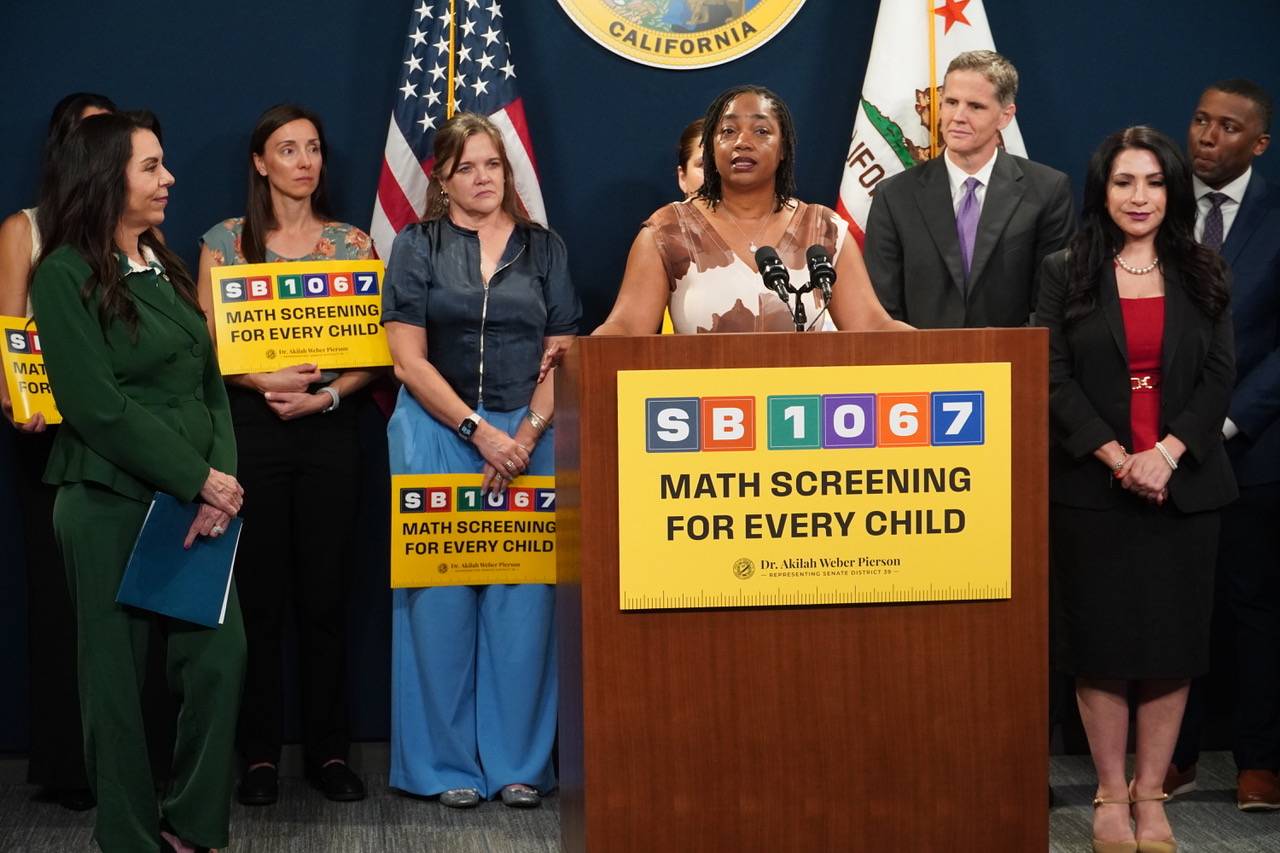
Senate Bill 1067 seeks to reduce achievement gaps and address potential bias in California math classrooms. The measure would establish an independent panel of experts to develop, by 2028, a list of approved screeners that are culturally, linguistically, and developmentally appropriate. Sen. Akilah Weber-Pierson (D-San Diego), at the podium, authored the bill. Co-authors include Asm. Blanca E. Rubio (D-Baldwin Park), left, and Sen. Susan Rubio (D-Baldwin Park), right. CBM
Statewide — Senate Bill (SB) 1067, introduced in February by Sen. Akilah Weber-Pierson (D-San Diego), seeks to close California’s racial achievement gap in education by requiring universal screening and early identification of math difficulties for students in kindergarten through second grade.
“California students are tested multiple times throughout their academic careers. Through the statewide California Assessment of Student Performance and Progress (CAASPP), students take math assessments in grades 3–8 and again in the 11th grade,” Weber-Pierson said. “These assessments provide important information about student learning, but they begin in the third grade, and by that time, many students who are struggling with foundational math skills have already fallen behind.”
Weber Pierson’s proposal comes amid growing concern about math performance statewide. According to the Public Policy Institute of California (PPIC), the share of students meeting or exceeding math standards rose slightly to 37.3% in 2025, up from 35.5% the previous year. However, disparities remain stark: only 18% of Black students and 21% of Latino students were proficient in math in 2025, meaning roughly four out of five students in those groups did not meet standards. Researchers say pandemic-related disruptions have widened these gaps.
Weber Pierson said SB 1067 is designed to help educators intervene earlier.
“SB 1067 does not add high-stakes testing. Instead, it introduces a simple early math screener to help educators identify learning gaps earlier and provide support before those challenges grow,” she said.
The senator outlined the measure at a March 17 news conference at the State Capitol Swing Space alongside co-authors Assemblymember Blanca Rubio (D-Baldwin Park) and Sen. Susan Rubio (D-Baldwin Park). Education advocates, including EdVoice CEO Marshall Tuck and UC Davis assistant professor Charles E. Wilkes II, also attended.
The bill would require school districts to adopt screening instruments by June 30, 2028, with assessments beginning no later than the 2028–29 school year. Results could not be used for high-stakes purposes such as teacher evaluations, grade retention or gifted identification. Parents would retain the right to opt their children out.
State data show the potential reach of the policy. In the 2024–25 school year, California public schools enrolled about 1,006,203 Latino students and 84,184 Black students in grades K–2. Weber-Pierson also noted that only 37% of California fourth graders performed at grade level in math in 2025, placing the state 43rd nationally.
“It’s frustrating for people who have worked in the education space and for those who have been looking at these numbers for decades — a generation — and seeing that, as a state, we have not prioritized education,” Weber Pierson told California Black Media. “We haven’t, and that’s why our numbers in reading and math are so low. But I am grateful that we are taking steps to fix it.”
Some researchers point to systemic factors driving disparities. A September 2024 Annie E. Casey Foundation report found Black students are twice as likely as their White peers to attend inadequately funded school districts and 3.5 times more likely to be in chronically underfunded ones. Studies cited by the National Center for Biotechnology Information suggest early tracking and teacher perceptions can disadvantage girls, students of color and low-income students.
Rubio, a former elementary school teacher, called SB 1067 a key step toward “strengthening outcomes and giving every child a fair shot at success,” adding, “Absolutely, there is bias” in how math learners are taught.
“We are trying to make sure all kids have the same opportunities that everybody else, regardless of who is raising them and what their circumstances are,” Rubio said. “I am grateful for Dr. Weber Pierson. We have been partners in trying to put the pieces together and hopefully, pretty soon, we’ll have the whole puzzle built so California kids can be successful.”
Wilkes said early achievement gaps reflect “a confluence of systemic variables,” including lower expectations and unequal resource distribution.
“There are a lot of strengths, a lot of culture, and a lot of linguistic resources that we are not taking advantage of,” he said. “For one, we have to address what those biases are because they do exist. They are the fabric of our state and country. We have to address them, but it has to be a collaborative effort.”
The bill has drawn support from advocacy groups such as EdVoice and Families in Action for Quality Education, though some school boards and educators have raised concerns about state-mandated screenings.
Arun Ramanathan, CEO of PowerMyLearning, said he is “very supportive” of early math screening but noted “there is no real strong consensus in the field as to what constitutes children who are falling behind in math.”
Tuck said the screenings would give educators actionable information.
“We are not gathering information and doing nothing with it,” he said. “The information is about giving more information to teachers, principals, counselors, and teacher’s aides so they can make the adjustments in the classrooms and at schools to help kids catch up.”