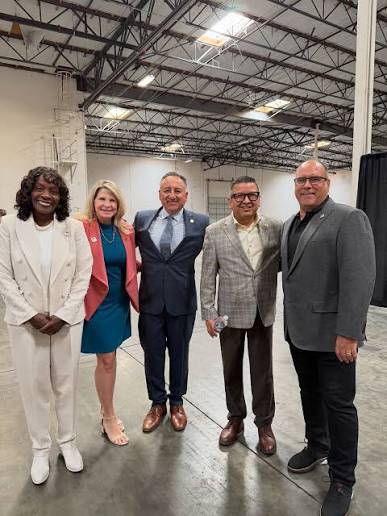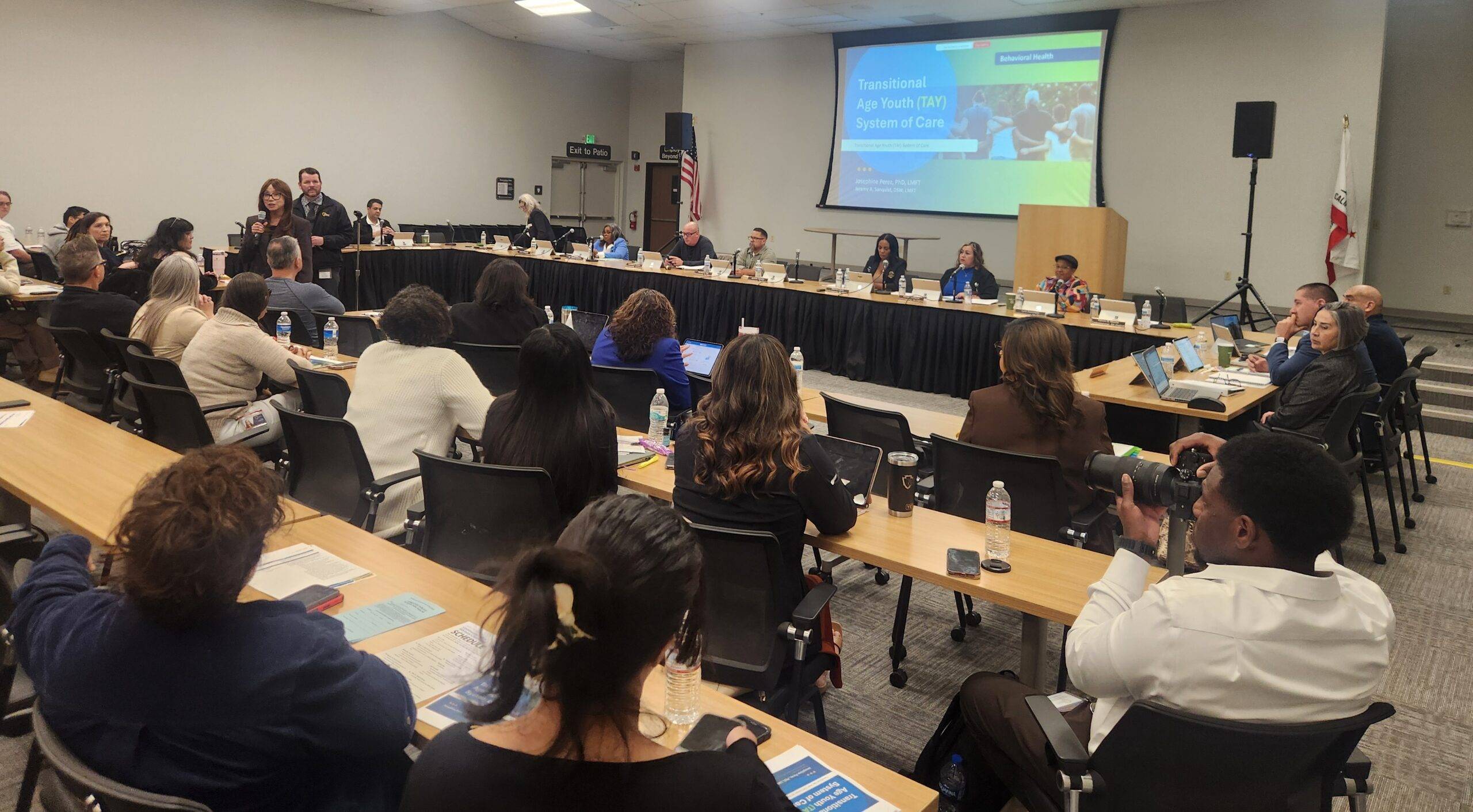
Members of the San Bernardino County Behavioral Health Commission gather with attendees during the commission’s April 2nd meeting at the County of San Bernardino Behavioral Health Services Auditorium in Rialto. / IVN Photo by Aldon Stiles.
San Bernardino, CA — Youth mental health advocacy, housing needs and sweeping changes to California’s behavioral health system took center stage during the San Bernardino County Behavioral Health Commission’s April 2 meeting.
The commission convened from noon to 2 p.m. at the county’s Behavioral Health Services Auditorium in Rialto, with additional participation from satellite locations in Apple Valley and Yucca Valley.
The monthly meeting also served as a public hearing on the county’s Behavioral Health Services Act (BHSA) Integrated Plan, a new framework that will guide funding and services beginning in 2026.
The Behavioral Health Commission advises the county Board of Supervisors and behavioral health leadership on local needs, programs and policies and meetings are open to public participation.
Public comment opened with emotional testimony from community members, including youth advocates who emphasized the urgency of addressing mental health among young people.
Carrie Fu, a junior at Los Osos High School, told commissioners that “one in five teens experience a mental disorder each year and most never receive treatment,” urging structural changes such as mental health education, expanded counseling access and policy reform.
“Awareness alone is not enough,” Fu said. “We must also advocate for clear policy and structural reform.”
Her remarks were followed by additional comments underscoring the importance of youth voices in behavioral health discussions.
Commissioners also heard from medical professionals and service providers about emerging public health concerns.
Dr. Julian Kazarian, a medical director working in the region, warned about the increasing presence of kratom and other substances in local communities, describing the substance as “an opioid” that can lead to withdrawal symptoms similar to fentanyl.
“We need to keep this out of our kids’ hands,” Kazarian said.
The meeting’s central presentation focused on Transitional Age Youth (TAY) services, which target individuals ages 16 to 25 navigating mental health challenges, housing instability and transitions into adulthood.
Dr. Josephine Perez, who leads the program, described TAY as both a service model and a support system built around individualized care.
“We serve the unserved, the underserved and the inappropriately served,” Perez said, explaining that the program offers therapy, housing support, employment assistance and life-skills training.
According to the presentation, more than 1,100 young people sought services through TAY programs in recent years, with therapy and employment support among the most requested services.
Youth participants shared firsthand accounts of how the program impacted their lives. One speaker said the program helped them move from homelessness to employment, while another described finding purpose after struggling with untreated mental health issues.
“My life is worth living,” one participant said, crediting case managers and therapists with helping them regain direction.
Commissioners used the discussion to highlight broader systemic gaps, including stigma in communities of color and barriers to accessing care.
In addition to youth-focused services, commissioners discussed ongoing county efforts to address homelessness and expand behavioral health infrastructure.
Chair Jonathan Cahow reported visiting programs across the county, including facilities in Barstow, and emphasized the importance of connecting individuals experiencing homelessness to services.
“There’s some sincere thoughts to get people off the street and getting the services up there,” Cahow said.
The meeting also included a detailed overview of the Behavioral Health Services Act, which replaces the state’s Mental Health Services Act following voter approval of Proposition 1 in 2024.
Maribel Gutierrez, deputy director of community engagement and equity services, said this law shifts priorities toward housing, substance use treatment and services for the most vulnerable populations.
The act continues to be funded by a 1% tax on incomes over $1 million and includes billions in bond funding for housing and treatment infrastructure.
Gutierrez said community input played a major role in shaping the county’s three-year integrated plan, with more than 130 meetings and hundreds of surveys informing priorities.
Among the top concerns identified were housing, access to services and outreach.
“Safe and stable housing is an important part of mental health,” Gutierrez said.
Despite the extensive outreach, officials acknowledged gaps in engagement, particularly among younger residents, and said additional efforts will be made to increase participation.
The meeting concluded with announcements about upcoming events, including community engagement initiatives and future commission meetings.
As the county prepares to implement the BHSA framework, commissioners emphasized the importance of continued public input and collaboration.
“Your work matters like you can’t believe,” Cahow told attendees.