
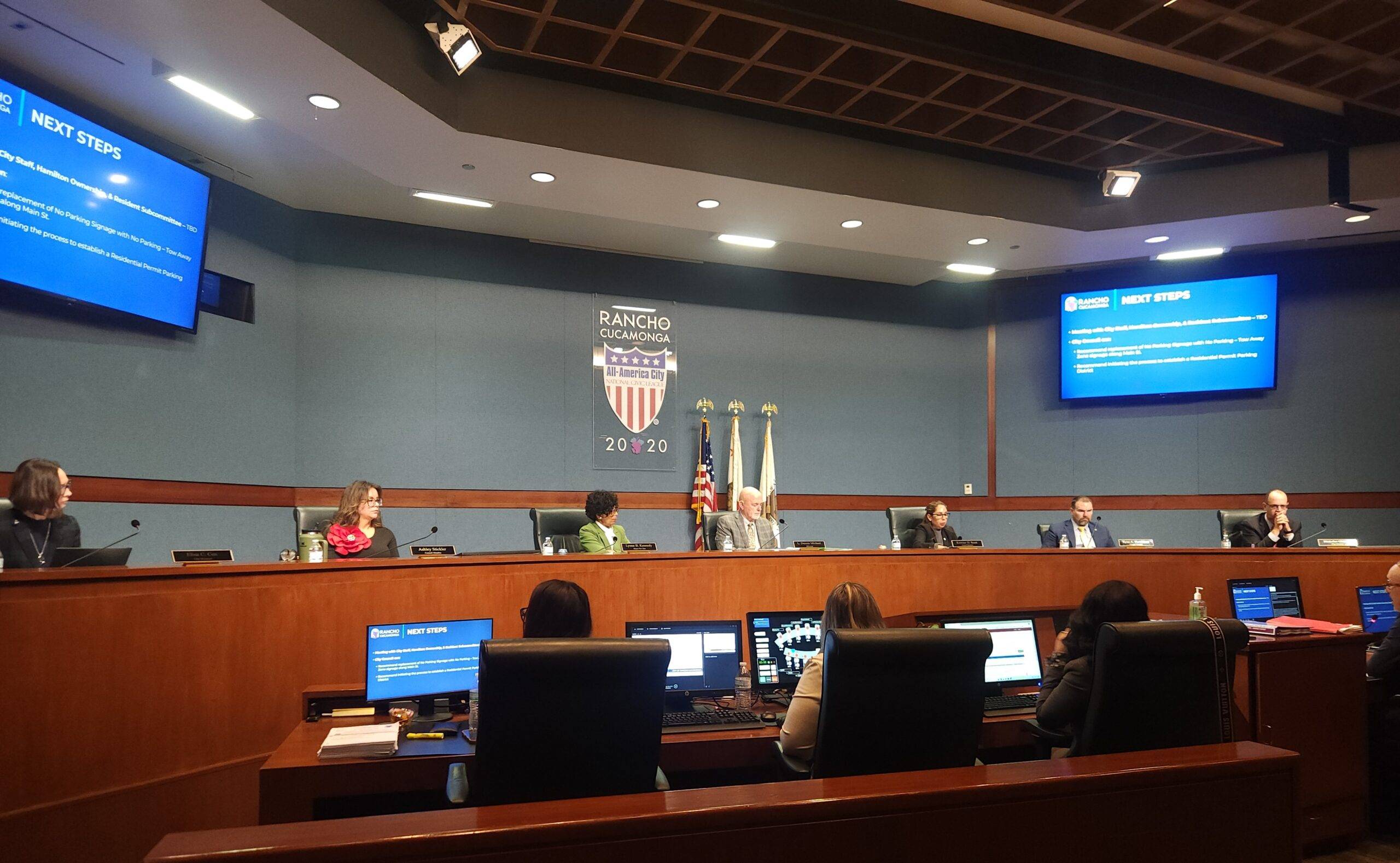
Rancho Cucamonga’s council members on the dais listened intently to a wide range of concerns at the city council meeting, April 1, 2026. / Photo by: Aldon Stiles, IVN
Rancho Cucamonga, CA — The Rancho Cucamonga City Council meeting on April 1 drew a wide range of public concerns, including immigration enforcement activity near the courthouse, homelessness, neighborhood safety and proposed development projects.
The meeting, held at City Hall on Civic Center Drive, included both routine business and extended public comment, where residents and workers addressed city leadership on issues affecting daily life in the community.
Several residents raised alarms about federal immigration enforcement activity near the local courthouse.
One speaker described witnessing what they called “upwards of 50 abductions,” alleging that federal agents were detaining individuals after court appearances.
Another resident urged the council to take action, saying the city should “show the moral courage and take a stand against these unethical, potentially dangerous tactics.”
In response, Rancho Cucamonga Police Chief Captain Mike Smith clarified the city’s limited role.
Citing California law, Smith said, “Senate Bill (SB) 54 strictly limits our cooperation with any kind of immigration enforcement,” adding that the courthouse and its parking facilities are state-owned, restricting the city’s jurisdiction.
The official emphasized that local authorities do not participate in federal immigration enforcement, stating, “We don’t get involved in any of these things, especially enforcement of immigration.”
Homelessness was another central issue raised by both residents and city officials.
Some speakers expressed concern about encampments and their impact on neighborhoods, calling for stronger enforcement and public safety measures.
City officials provided updated data on homelessness, noting a decrease in the number of unhoused individuals.
“The annual point in time count in 2025 was about 120 individuals,” one official said, adding that a preliminary 2026 count suggests “about 90 individuals,” indicating a decline.
Officials also outlined several programs aimed at addressing homelessness, including outreach teams and partnerships with county agencies.
These efforts focus on providing services such as mental health support, rehabilitation, and housing assistance.
However, Rancho Cucamonga Mayor L. Dennis Michael acknowledged limitations, noting that participation in many programs is voluntary.
“We cannot force somebody to not be homeless if they don’t want to be homeless,” he said, referencing legal constraints and ongoing processes tied to new state laws.
Beyond homelessness and immigration, residents raised concerns about local infrastructure and development.
One speaker criticized traffic conditions at Haven Avenue, calling a redesigned intersection “the most ridiculous intersection I have ever encountered” and urging council members to experience the area firsthand.
Others voiced opposition to proposed housing developments, particularly near Etiwanda High School.
One resident advocated for preserving land for public use, suggesting the city “make it a park, a big community park,” instead of increasing housing density.
City employees and labor representatives also addressed the council, focusing on workforce conditions.
Jose Rivera, a representative from Teamsters Local 1932, emphasized the importance of retaining skilled workers.
“If the city wants reliable services, it must invest in a stable workforce,” Rivera said.
Workers echoed concerns about staffing, compensation, and working conditions, highlighting the role of public works employees in maintaining city infrastructure and public spaces.
The council also conducted routine business through its consent calendar, approving items such as payroll totaling more than $2.4 million and check registers exceeding $4.1 million.
Additional approvals included contracts for infrastructure maintenance, vehicle purchases and city services.
The meeting also featured proclamations recognizing April as Child Abuse Prevention Month and Donate Life Month, along with awards from the California Park & Recreation Society.
Throughout the evening, council members heard a mix of praise and criticism, reflecting ongoing tensions around growth, public safety, and quality of life in the city.
Residents repeatedly called for transparency and accountability, particularly regarding development decisions and public safety concerns.
As one resident put it, “The residents I represent tonight want to preserve those standards.”