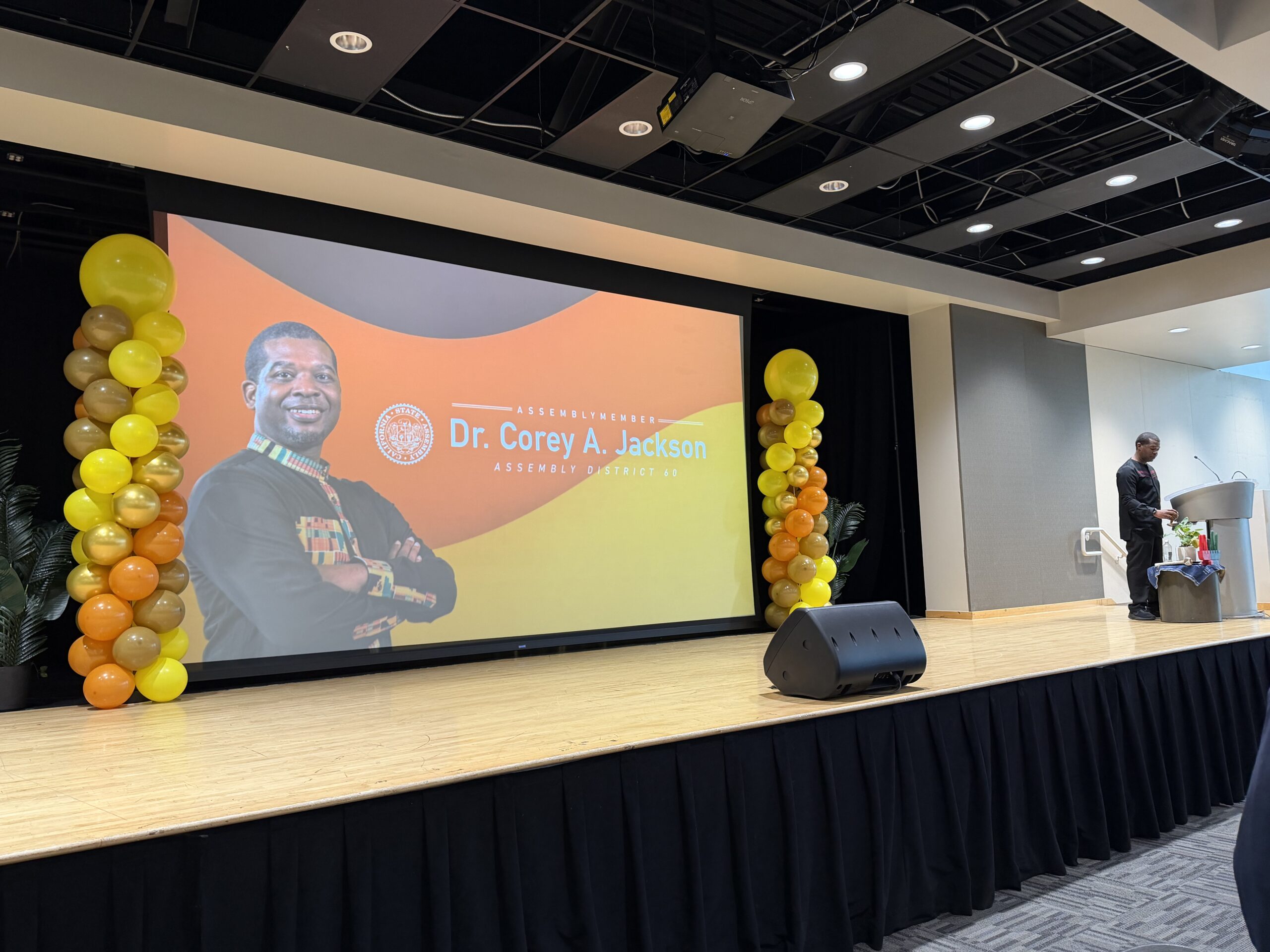
Assemblymember Dr. Corey A. Jackson (D-Moreno Valley) addresses attendees during an Oct. 10 gathering in Moreno Valley focused on advancing Black equity across the Inland Empire. The event brought together community leaders, advocates and residents to discuss economic opportunity, education, maternal health and strategies for building stronger, more empowered Black communities.
Moreno Valley, CA — Black community leaders, elected officials, health advocates and residents gathered in Moreno Valley on Saturday, Oct. 10, to examine the future of African Americans in the Inland Empire, highlighting the region’s growing Black population while calling for greater investment in economic opportunity, education, maternal health and political empowerment.
The gathering, led by Assemblymember Dr. Corey Jackson (D-Moreno Valley), focused on the importance of building strong Black institutions and creating sustainable solutions to longstanding disparities.
“If they ain’t gonna do it, we gotta build it ourselves,” Jackson told attendees, emphasizing that communities must take responsibility for building the infrastructure necessary to preserve Black identity, create generational wealth and strengthen political influence.
Jackson, who announced that his colleagues selected him to serve as the next chair of the California Legislative Black Caucus, outlined several legislative accomplishments aimed at addressing systemic discrimination and expanding opportunities for Black Californians.
Among the measures he highlighted were AB 2599, requiring large corporations to disclose historical connections to slavery, and SB 1348, establishing California’s Black-Serving Institution designation for colleges and universities. Riverside City College and San Bernardino Valley College were among the institutions Jackson recognized.
While acknowledging legislative progress, Jackson stressed that passing laws alone would not produce meaningful change without community involvement and accountability at the local level.
“We have got to be involved everywhere to make sure that they’re not just doing the bare minimum,” he said.
The urgency of that message was reinforced by Alex Reed, project manager for Mapping Black California, who presented findings from the latest Inland Empire Black Equity data report examining population, health, education, wealth, housing and civic participation.
According to Reed, the Inland Empire currently has California’s third-largest Black population.
Moreno Valley has approximately 35,000 Black residents, representing about 16% of its population. San Bernardino follows with approximately 25,000 Black residents, while Victorville has about 22,000.
Despite that population growth, Reed said significant economic disparities continue to limit opportunities for Black families.
Nearly 38% of all Inland Empire households earn less than the estimated income necessary to meet basic living expenses. Black men earn approximately $53,000 annually, compared with $60,000 to $65,000 for White and Asian men.
Housing remains another major challenge. Only 46% of Black households in the region own their homes, making Black residents the only racial group examined in the report with more renters than homeowners.
Black residents also represent approximately one-quarter of the region’s unhoused population, despite accounting for a considerably smaller share of its overall population.
Reed called for increased funding for Black-led organizations, expanded access to homeownership, better-paying jobs and investments in historically underserved neighborhoods.
Those disparities also extend to healthcare, particularly among Black mothers and infants.
Curley Palmer, a Riverside County maternal and child health advocate, reported that Black infants die at approximately twice the rate of infants from other racial groups, while Black mothers experience pregnancy-related mortality at four times the rate.
Palmer discussed the work of the Save Our Babies coalition, which has brought together healthcare professionals, community advocates and organizations to improve maternal and infant health outcomes across Riverside and San Bernardino counties.
Chantel Reynolds, executive director of Sankofa Birth Workers Collective, emphasized the importance of doulas and midwives in improving birth outcomes and ensuring that Black families receive culturally responsive care.
Although Medi-Cal began covering doula services in January 2023, Reynolds said significant barriers remain, particularly as maternity services have closed at hospitals in Hemet and Corona.
“Access does not always equal coverage,” Reynolds said, urging healthcare providers and managed care plans to improve access and coordination.
Education was another central focus of the gathering. Richard Barrera, president of the San Diego Unified School District Board of Education and a candidate for California superintendent of public instruction, pointed to his district’s efforts to expand college opportunities for Black and Latino students.
Barrera said the percentage of Black and Latino graduates eligible to apply to California’s public universities increased from approximately 25% to 75% after the district expanded access to college-preparatory courses.
He argued that California must invest more aggressively in public education, including teacher compensation, affordable housing for school employees and improved facilities.
Throughout the gathering, speakers returned to the importance of political participation and community accountability.
Reed reported that Black voter participation in presidential elections reaches approximately 74% in the Inland Empire but drops to 39% during midterm elections.
Jackson urged residents to remain engaged, support Black leadership and build alliances without compromising the community’s priorities.
“You can be unapologetically Black and pro-humanity at the same time,” Jackson said.
As the Inland Empire’s Black population continues to expand, speakers emphasized that population growth alone will not guarantee progress. They challenged residents to transform that growth into lasting economic power, stronger institutions, healthier families and opportunities for future generations.
The full regional data report is available at BEIDataReport.com.