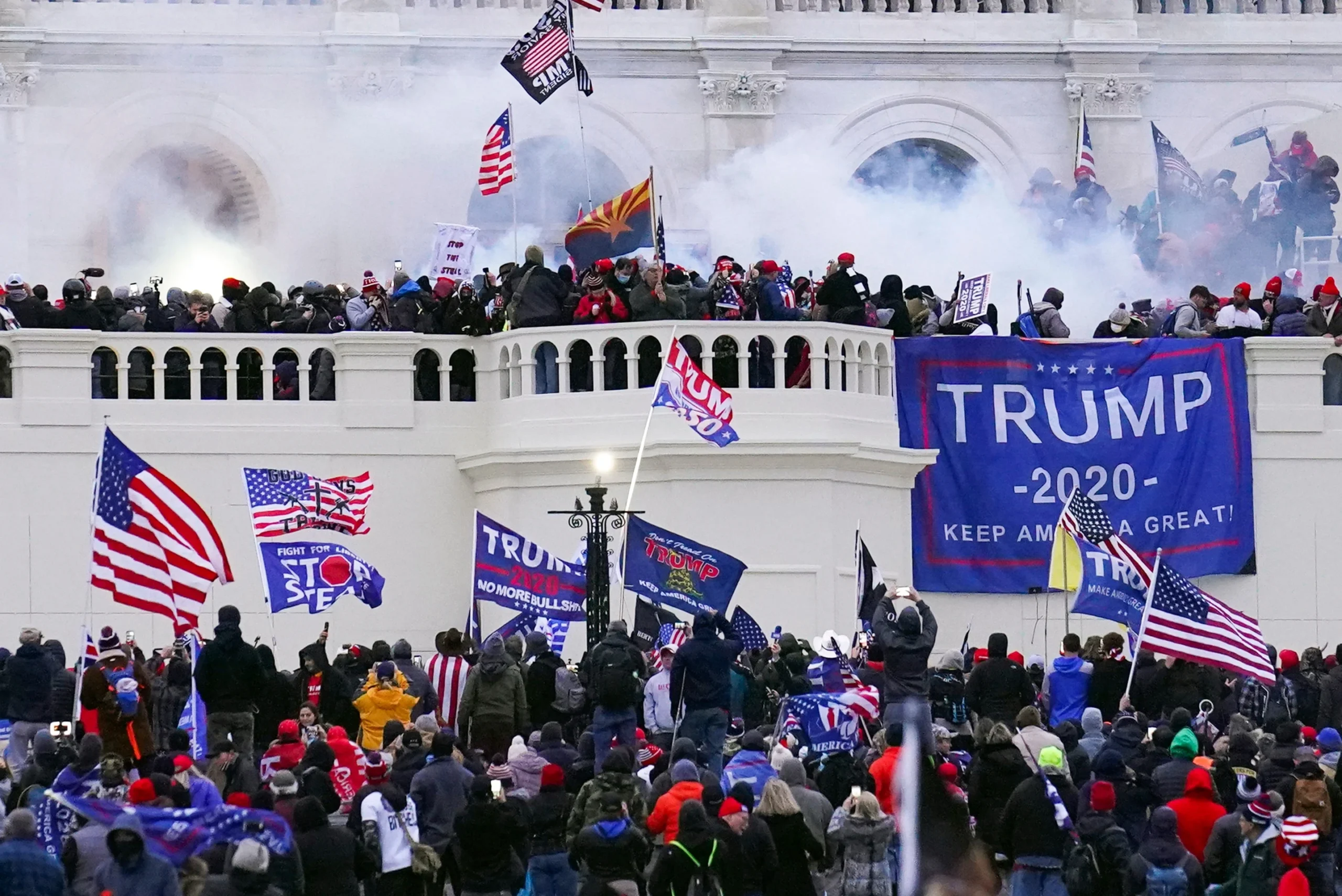
Rioters storm the West Front of the U.S. Capitol Jan. 6, 2021, in Washington. (AP Photo/John Minchillo, File)
Two law enforcement officers who defended the U.S. Capitol during the January 6, 2021, riot are now suing to block potential payouts connected to a controversial federal compensation program that critics say could financially benefit individuals convicted in the attack on the Capitol.
The lawsuit comes as the Trump administration faces mounting scrutiny over a proposed $1.776 billion “Anti-Weaponization Fund,” a program designed to compensate Americans who claim they were unfairly targeted, investigated or prosecuted by the federal government for political reasons.
The issue erupted into the national spotlight this week during a heated Congressional budget hearing involving Acting U.S. Attorney General Todd Blanche, who appeared before lawmakers to defend the Justice Department’s proposed budget and answer questions surrounding the administration’s compensation initiative.
During the hearing, lawmakers repeatedly pressed Blanche on whether individuals convicted in connection with the Jan. 6 Capitol attack — including those accused of assaulting police officers — could potentially receive taxpayer-funded compensation through the program.
Rather than ruling them out entirely, Blanche stated that eligibility decisions would ultimately be handled by an independent five-member commission appointed by the attorney general.
“What I will commit to is making sure the commissioners are effectively doing their jobs,” Blanche said during testimony. “That includes setting appropriate guidelines.”
That response immediately drew sharp criticism from lawmakers and Capitol officers who say the proposal risks rewarding individuals involved in one of the most consequential attacks on American democracy in modern history.
For the officers now challenging the program in court, the issue is deeply personal.
Many of the officers involved in the Jan. 6 response suffered physical injuries and emotional trauma while defending lawmakers, staff and the Capitol building from thousands of rioters attempting to halt certification of the 2020 presidential election.
Some officers were beaten, sprayed with chemical irritants, pinned in doorways and threatened during hours of violent chaos that unfolded inside and outside the Capitol.
The officers argue that allowing convicted rioters to receive compensation would undermine accountability, dishonor injured law enforcement personnel and further deepen political divisions surrounding the events of Jan. 6.
The legal challenge also raises broader constitutional and political questions about the role of government, the independence of the justice system and the increasing politicization of federal law enforcement.
Critics of the proposed fund say it represents an attempt to reframe Jan. 6 participants as victims of political persecution rather than individuals convicted through the judicial process.
The controversy follows a series of pardons and sentence commutations issued by President Donald Trump for several individuals convicted in connection with the riot, along with the dismissal of some prosecutors tied to Jan. 6 cases.
Supporters of the initiative, however, argue the compensation fund is intended to address broader concerns surrounding political bias within federal investigations and prosecutions — not solely Jan. 6 defendants.
Blanche defended the proposal by insisting the fund would theoretically apply to anyone who believes they were subjected to politically motivated investigations, regardless of political affiliation.
“It’s not limited to January 6th defendants,” Blanche testified. “It’s limited only by the term weaponization.”
Still, administration officials have yet to clearly define what qualifies as “weaponization” under the program, leaving legal scholars, lawmakers and advocacy groups questioning how the process would operate and who could ultimately qualify for compensation.
The proposal has also exposed divisions within Republican leadership.
Senate Majority Leader John Thune publicly acknowledged concerns about the initiative, while Louisiana Sen. Bill Cassidy reportedly criticized the idea as potentially becoming a political “slush fund.”
Political analysts say the growing legal battle surrounding the compensation proposal reflects a deeper national divide over accountability, public trust and the future independence of the justice system in an increasingly polarized political climate.
More than five years after the Capitol attack, Jan. 6 continues to remain one of the nation’s most politically charged flashpoints — one that still shapes debates over law enforcement, democracy, political retaliation and the boundaries of federal power.
As lawsuits move forward and Congress continues demanding answers from the Justice Department, the proposed compensation fund is expected to face intense legal, political and public scrutiny in the months ahead.
For communities across the Inland Valley and Carson, the debate also highlights a broader concern increasingly felt nationwide: whether America’s justice system can remain trusted and independent amid rising political polarization and competing narratives surrounding accountability and power.