
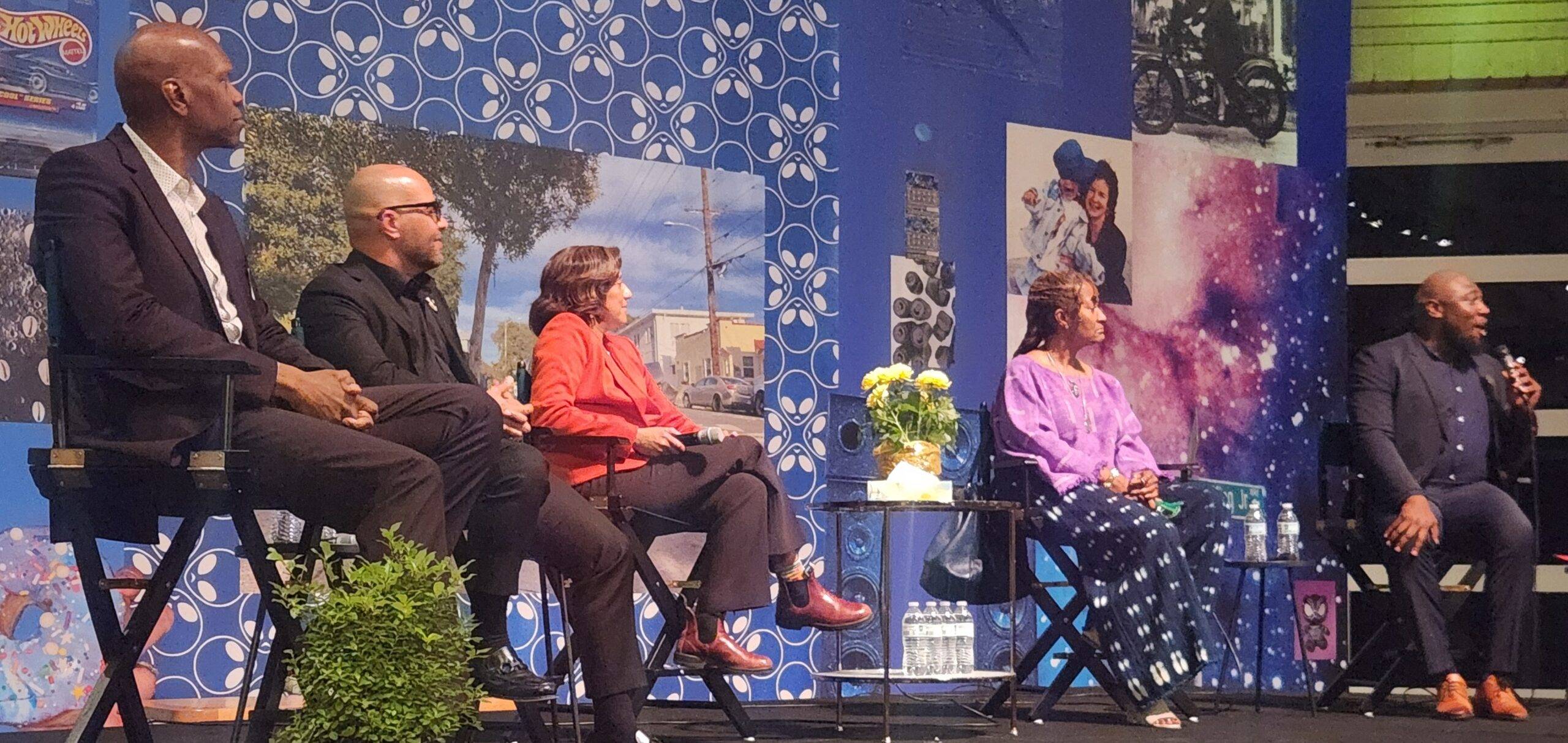
From L to R: Henry Hipps, CEO and co-founder of Diffusion Venture Studio, George Fatheree, founder and CEO of OROImpact, Brenda Solórzano, president and CEO of The California Endowment, and Los Angeles County Supervisor Holly J. Mitchell, and Dr. Ryan J. Smith, president and CEO of St. Joseph Center, led the panel in a moving discussion on thescale of housing instability and the urgency of solutions that match the depth of the problem.
Los Angeles, CA — Leaders from county government, philanthropy, impact investing and entrepreneurship gathered Feb. 25 at the California African American Museum (CAAM) for “Building Black Futures: Opening Doors to Home and Opportunity,” a conversation focused on the intersection of housing, racial justice and economic mobility in Black communities.
Co-sponsored by CAAM and St. Joseph Center and launched in 2025 with support from the Weingart Foundation, “Building Black Futures” is part of St. Joseph Center’s salon series intended to convene cross-sector voices aroundequity, community and shared responsibility, according to organizers.
Dr. Ryan J. Smith, president and CEO of St. Joseph Center, opened the program by welcoming attendees and situating the event within Black History Month.
“You are at our second annual Building Black Futures event,” Smith said.
He described the night as a moment for people to come together to serve a larger purpose.
Smith also offered a brief history of the nonprofit, saying St. Joseph Center was founded by “an amazing group of sisters” who decided they needed to combine learning about social justice and actively participating in it.
He told the audience the organization’s work is guided by three commitments — nourishing people, housing people andempowerment — with an emphasis on prevention and economic stability.
“Our organization is really focused on three commitments,” Smith said, describing efforts that range from food justiceand wraparound mental health support to housing placement and job pathways. “We believe that we can address the homelessness in this generation.”
He also pointed to workforce programs, including a culinary training initiative, as part of the organization’s approach to helping people sustain housing through stable income.
CAAM Executive Director Cameron Shaw welcomed guests to the state-supported museum and emphasized the institution’s longstanding mission.
Founded in 1977, CAAM is “the first state-supported museum of African American art, history and culture,” she said.
Shaw told attendees that it was “particularly fitting” to host the conversation during Black History Month, describing the museum’s role in presenting Black history, art and culture year-round.
The evening’s panel, moderated by Smith, included Los Angeles County Supervisor Holly J. Mitchell; Brenda Solórzano, president and CEO of The California Endowment; George Fatheree, founder and CEO of ORO Impact; and Henry Hipps, CEO and co-founder of Diffusion Venture Studio.
A key thread through the discussion was the scale of housing instability and the urgency of solutions that match the depth of the problem.
During her remarks, Mitchell pointed to the disproportionate representation of Black residents among those experiencing homelessness in Los Angeles County.
“When 30% of the people experiencing homelessness are black, and we’re only 8% of the population, that is a crisis that we must address,” Mitchell said.
Fatheree, whose work has included advocacy tied to historic Black land loss, framed the wealth gap through a personal story about unequal starting points at graduation and the compounding effect of homeownership.
“For graduation, my mom bought me a chair,” he said.
He contrasted that experience with a college roommate whose parents “made a down payment” on a condominium.
Fatheree then cited research he said illustrates how long it could take to reach parity under current conditions.
“It would take 218 years, two centuries, for the average Black family to have the same wealth [as the average White family],” he said.
He argued that closing the gap requires strategies that go beyond individual achievement narratives.
“It’s systemic,” Fatheree said.
Solórzano, whose foundation helped launch the series in 2025, spoke about the role of philanthropy in supporting cross-community problem-solving rather than reinforcing competition for scarce resources.
She described Los Angeles as diverse yet highly segregated, and said philanthropy should help create spaces where communities can “bring together people” to think differently about democracy and shared solutions.
Hipps focused on how technology is reshaping work and opportunity, and urged attendees to build familiarity with the tools young people are inheriting.
“If you do not understand, even at a rudimentary level, how the world is changing every day by the way of these tools, you are going to get caught off guard as the world shifts under your feet,” he said.
The conversation repeatedly returned to the idea that durable change requires long-term commitments, including investments whose results may not be fully realized in the current generation.
The “Building Black Futures” series, organizers said, is intended to keep those cross-sector conversations going beyond Black History Month, with housing and economic opportunity at the center.