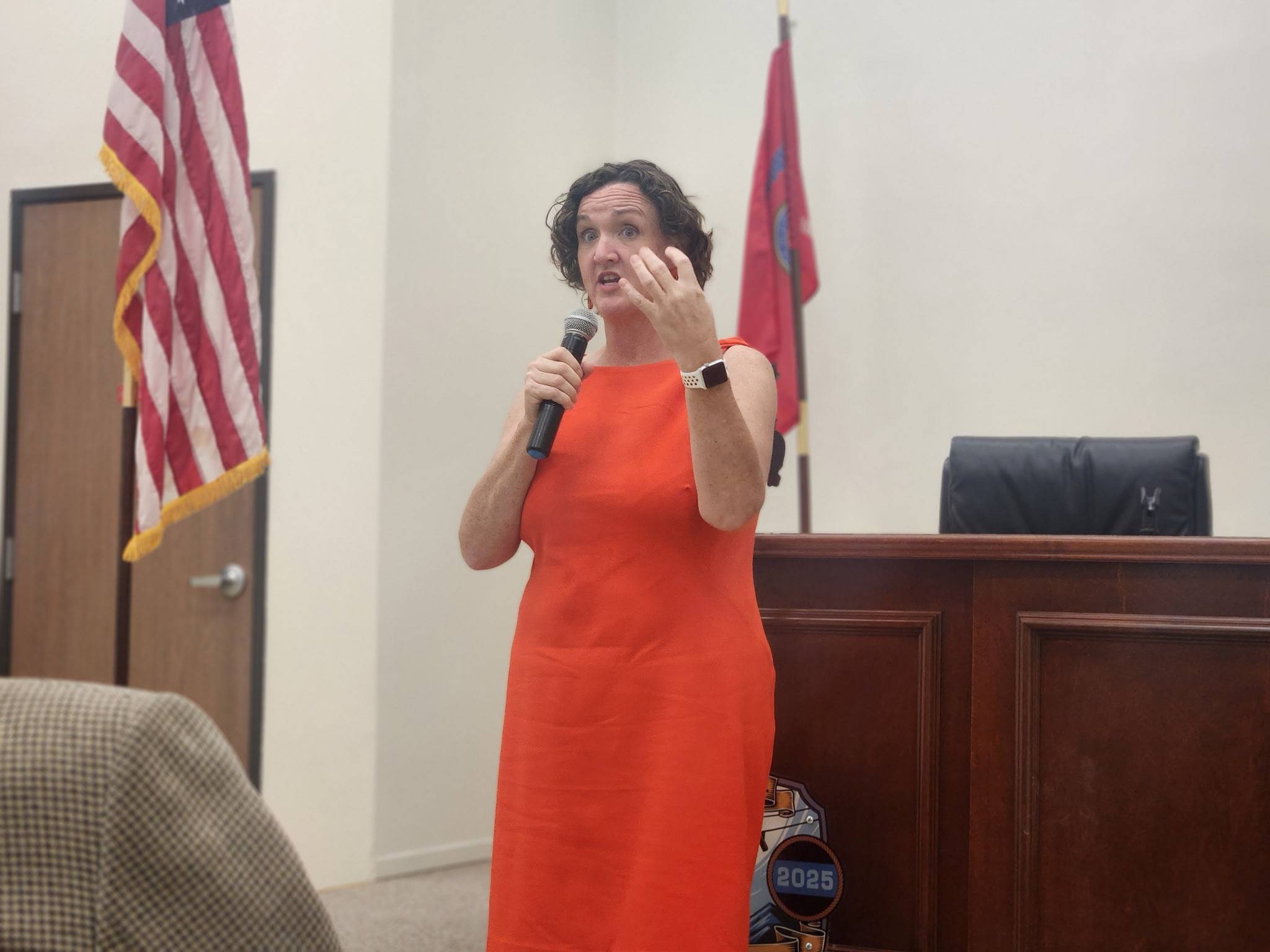
Gubernatorial candidate Katie Porter and Asm. Corey A. Jackson engages with Riverside residents at the I.B.E.W. Local #47 on March 21.
Riverside, CA — Democratic gubernatorial candidate Katie Porter centered her Inland Empire campaign stop on affordability, health care and education, telling a Riverside audience that California’s future depends on lowering costs and expanding access to opportunity.
Speaking during a March 21 meet-and-greet hosted by Assemblymember Corey A. Jackson at IBEW Local 47, Porter framed the event as a listening session while outlining key components of her platform.
“This is about a conversation, this is about my listening and my learning, not just my talking at you,” Porter said at the outset of the Q&A session.
Porter, a former Orange County congresswoman, repeatedly returned to affordability as a unifying issue across policy areas, particularly housing.
She argued that the state’s housing shortage is driving both economic stagnation and homelessness.
“If we cannot house our workforce, we will not grow our workforce,” she said. “If we’re not growing our population, we are not growing our economy.”
She emphasized that homelessness in California is closely tied to high housing costs rather than higher rates of mental illness or substance use compared to other states.
“We have more unsheltered homelessness because the housing prices are higher here,” Porter said, adding that preventing homelessness before it occurs should be a central strategy.
Her proposals include expanding eviction prevention programs and increasing housing supply through locally tailored solutions rather than one-size-fits-all mandates from Sacramento.
Porter also highlighted child care as critical economic infrastructure, arguing that lowering costs would directly boost workforce participation.
“The fastest way we can grow our economy in California is to invest in bringing down the costs of child care,” she said.
On education, Porter called for a return to tuition-free public higher education, proposing a pathway that combines two years of free community college with two tuition-free years at a University of California or California State University campus.
“Everybody understands free,” she said, describing the policy as both an economic investment and a signal to residents that the state is “putting their tax dollars to work for them.”
During the Q&A portion, Porter fielded questions on single-payer health care, small business contracting, education policy and environmental justice.
On health care, Porter reiterated her long-standing support for a single-payer system, while acknowledging challenges at the federal level.
“I have a very, very strong track record on supporting Medicare for All at the federal level,” she said.
However, she suggested California may need to pursue its own approach given instability in federal funding.
“I think California is going to have to go its own way,” Porter said, pointing to rising costs and reduced federal support as factors reshaping the debate.
In a one-on-one interview following the event, Porter expanded on the intersection of health care and environmental policy, particularly in communities impacted by warehouse development and port pollution.
“What we don’t often measure is what is the cost of not acting,” Porter said.
She argued that pollution-related health impacts, disproportionately affecting Black and Brown communities, must be factored into policy decisions.
“And health care is where we experience that cost,” she added, noting that environmental exposures contribute to long-term medical expenses and disparities.
Porter pointed to technological solutions, such as emissions capture systems at ports, as examples of investments that may carry upfront costs but reduce long-term harm.
“There is a cost to not doing it, too,” she said, referring to environmental regulations and cleaner transportation infrastructure.
Audience members also pressed Porter on economic equity, including access to government contracts for small businesses.
She proposed reforms to bidding processes and contract structures.
“Having something like a three bid or a five bid minimum also helps you better have a chance to be able to bid for work,” she said.
She also suggested breaking large contracts into smaller components to allow more local businesses to compete.
On education policy, Porter voiced support for strengthening public schools and reducing the influence of privately funded reform efforts.
“I do not take money from people who support charter school reform,” she said, adding that California must evaluate whether existing funding formulas are effectively closing achievement gaps.
Porter also addressed broader structural issues, including workforce development and artificial intelligence.
She warned that rapid technological growth must be balanced with environmental and labor considerations.
“Our energy demand is going to go up by 50% in the next 10 years,” she said, noting that data centers and AI will account for a significant portion of that increase.
She proposed requiring AI-related infrastructure to generate or offset its own energy use and emphasized that new technologies should be evaluated based on their real-world benefits.
“We also have to ask a fundamental question. Not, can we do it technologically, but does this make life better for people?” Porter said.
Throughout the event, Porter positioned herself as a candidate focused on everyday economic pressures facing Californians, frequently referencing her experiences as a single mother.
“These are real conversations that are happening in my home,” she said, describing discussions with her children about affordability and the future of living in California.
With a crowded gubernatorial field, Porter acknowledged the competitive nature of the race but emphasized her intent to build support through direct engagement.
“My job is not to tell you to vote for me, it’s to earn your vote,” she said.
The Riverside stop is part of Porter’s broader effort to connect with Inland Empire voters, a region she identified as critical to California’s economic growth and policy direction.