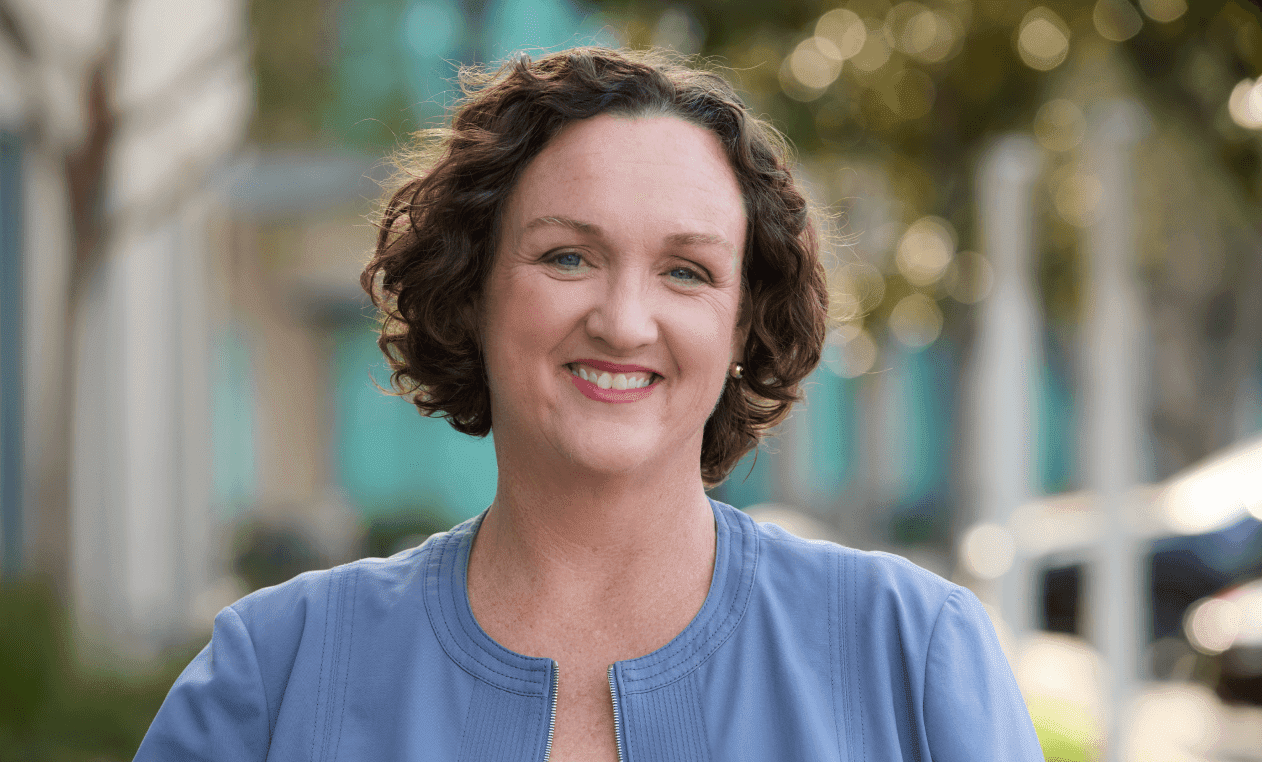
The Hon. Katie Porter, Democratic candidate for Governor State of California
Editor’s Note:
This California Black Media Q&A series with California’s gubernatorial candidates is intended to inform voters about where the candidates for governor stand on key issues. The opinions, assertions, and claims expressed are those of the candidates and have not been independently verified; they may or may not be supported by publicly available data.
Once seen as a leading contender to succeed Gov. Gavin Newsom, former California U.S. Rep. Katie Porter spent much of the summer and early fall of 2025 at the top of many Democratic primary polls.
In some surveys, she held a clear edge over her rivals, and she earned significant early endorsements that fueled her momentum.
But the glow dimmed in the months that followed as her support eroded amid a series of campaign setbacks and shifting voter preferences, with recent statewide polling showing her trailing other contenders and well behind the front of the pack. At the 2026 California Democratic Party Convention, which was meant to help shape party endorsements, Porter ultimately placed fifth in the internal delegate vote with roughly 9 % support, behind figures like Eric Swalwell, Betty Yee, and Xavier Becerra.
California Black Media (CBM) spoke with Porter on new ideas in her platform, promising to stand up to Trump in Washington and her willingness to collaborate with the California Black Caucus and reparations task force if elected.
The interview has been edited for length and clarity.
What is motivating you to run for Governor of California?
I think with Trump in the White House, we really need a governor in California who’s going to stand and be fearless in protecting Californians. We’re seeing attacks on healthcare. We’re seeing attacks on our workforce, and we’re seeing attacks on our education system. As a member of Congress, I took on Trump. I held his advisors and his cronies accountable, both in congressional hearings and in the real world. So, I think making sure that we have someone who continues to protect California when we’re under attack.
In your campaign video you talk about fresh ideas, and especially with the crowded candidacy. What are some of your fresh ideas? What do you think separates you from the crowd?
I’m the only candidate in this race who’s not taking contributions from corporations. I can’t be bought, not by anybody. So that’s why I think voters can trust me to focus on good ideas.
With regard to some of the ideas I’ve been working on, one of them is focusing a lot on homelessness prevention. So, it’s not just what do we do when we have people experiencing homelessness, but how do we stop that from happening in the first place? And we haven’t done much on that. And I think that’s what people want to see. They don’t want to see people struggling. They don’t want to deal with the effects in our community and the harms that people are facing on the streets.
We want to get ahead of that and protect people – so that means things like eviction prevention and rapid rehousing. Can we identify people at risk before they get to that point? Because once they get there, it’s really a tough situation for them and for our whole community.
With regard to healthcare, I’ve done a lot of work in Congress on bringing down the cost of pharmaceuticals. I think there’s a lot California can do with CalRx and we have to think about how we can bring down those costs. It’s going to be really important.
If elected, what is your stance when it comes to working with the reparations task force or along with the legislative Black Caucus to tackle the most pressing issues for Black Californians.
California is so fortunate to have thoughtful and strong and talented, Black Caucus members who come from a lot of different professional backgrounds. And, so, I think we’ve seen their leadership on issues like making our communities safer, addressing issues of police violence, addressing issues in disparity in mental health care.
I think the reparations task force has been a really important process for Californians to understand what our history is of our nation, what the consequences of that history are, and what are the tools that we have at our disposal to do something about it.
I think you have to, as a leader, be honest about this. Black Californians face disparities. They continue to face disparities. This is not a problem of the past. This is an ongoing harm: worse health outcomes, less likely to own a home, more pollution in their neighborhoods. And so, I think we have to be really thoughtful about what are the different pathways to address that.
And I think the reparations task force came up with a number of different ideas, a number of different approaches that we could use. But I think we have to recognize that the reparations committee is about what we do about these harms of the past. But we also have to be thinking about how these proposals will build a better future for all Californians, regardless of race, including those who might not be descendants of of American chattel slavery, but might still be experiencing systemic racism and its harms in their communities.
What is your favorite thing about California?
California has such a sense of energy and a willingness to push forward. I think we see that going back in our history — both parts of our history we’re proud of and not proud of. But California has always determined what comes next.
That’s really what excites me about it. What comes next is how do we build green energy in a way that does not repeat the harms, the environmental injustices of the past? How do we look forward and do better than our past?
_________
By: Edward Henderson, Inland Valley News