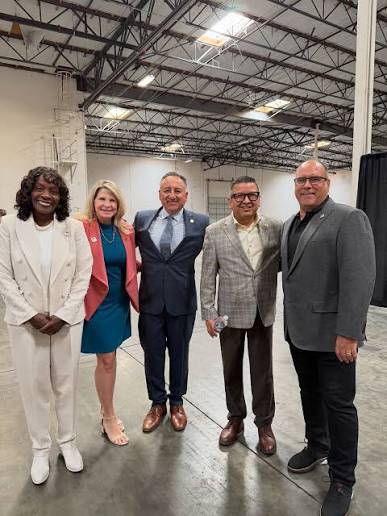
From L to R: City of Fontana Mayor Aquanetta Warren; SB County Supervisor Chairman Dawn Rowe; District 3; SB County Supervisor Joe Baca, District 5; SB Supervisor Jesse Aramandarez, 2nd District; SB Supervisor Curt Hagman, District 4. / Courtesy Photo
Fontana, CA – Seven Inland Empire cities and San Bernardino County are joining forces on a regional facility designed to provide shelter, medical recovery services and other assistance to people experiencing homelessness in the West Valley.
Construction began Sept. 8 on the West End Regional Navigation Center, which will transform an existing warehouse at 11109 Jasmine Street in Fontana into a facility capable of accommodating as many as 200 beds.
Plans call for approximately 100 shelter beds and another 100 recuperative-care beds, along with space for behavioral health services, case management and additional programs designed to help people move toward permanent housing and stability.
The project is a partnership between San Bernardino County and the cities of Fontana, Chino, Montclair, Ontario, Rancho Cucamonga, Rialto and Upland.
Fontana has awarded the construction contract to R.C. Construction Services Inc., which will complete tenant improvements at the existing warehouse.
The regional approach comes as homelessness remains one of San Bernardino County’s most persistent public-policy challenges.
The county’s 2026 Point-in-Time Count identified 3,718 people experiencing homelessness, a 3.1 percent decrease from 2025 and the second consecutive annual decline.
Of those counted, 2,448 were living without shelter and 1,270 were staying in temporary shelters or other homeless housing programs. Roughly two-thirds of the county’s homeless population was therefore unsheltered.
Despite the recent decrease, the number of people experiencing homelessness remains higher than it was several years ago. The county counted 3,333 homeless residents in 2022, meaning homelessness remained roughly 12 percent higher in 2026.
The demographics also reveal disparities within the population. Among unsheltered residents counted in 2026, approximately 19 percent identified as Black, according to county data.
The West End Regional Navigation Center represents an effort to address more than the immediate need for a bed.
Navigation centers typically seek to connect people experiencing homelessness with multiple services at the same location rather than requiring them to travel between agencies for shelter, health care, behavioral health treatment and housing assistance.
The inclusion of recuperative-care beds is particularly notable.
Recuperative care, sometimes called medical respite, provides temporary housing and support for people who are homeless but need a safe place to recover following hospitalization, illness or medical treatment.
Without such programs, people without stable housing may return to streets or encampments while still recovering from serious medical conditions.
City officials say bringing shelter, healthcare, behavioral health resources and case management together is intended to create a more coordinated path toward long-term housing.
The partnership also reflects the regional nature of homelessness in the Inland Empire. Residents experiencing housing instability frequently move between neighboring cities, while shelters and specialized services may be concentrated in only a few communities.
By participating jointly, the West End cities are attempting to create a shared system rather than placing responsibility on any single municipality.
The project now moves into the construction phase.
Additional details, including the center’s anticipated opening date, referral process, operating structure and eligibility requirements for residents seeking services, are expected as the project progresses.
Inland Valley News will continue following the development of the West End Regional Navigation Center and its impact on homelessness services throughout the region.