
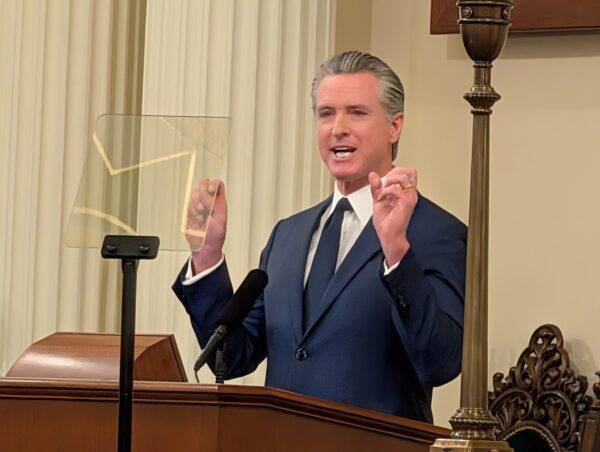
In his final State of the State address on Jan. 8, 2026, Gov. Gavin Newsom highlighted California’s role as a national “beacon” of progress. He also criticized the Trump administration’s federal policies, calling them a “carnival of chaos” and an “assault on our values.” / CBM photo by Antonio Ray Harvey.
Statewide — Gov. Gavin Newsom submitted a proposed 2026–27 state budget of $348.9 billion to the Legislature on Friday, pitching it as a balanced plan that adds to reserves while limiting new ongoing commitments, according to the governor’s official press release.
The administration framed the proposal as both a marker of confidence in California’s current fiscal position and a hedge against economic and federal uncertainty.
“California’s economy is strong, revenues are outperforming expectations and our fiscal position is stable because of years of prudent fiscal management — but we remain disciplined and focused on sustaining progress, not overextending it,” Newsom said in the press release.
During a Friday budget briefing, State Finance Director Joe Stephenshaw described the plan in similar terms, calling it a “workload budget” that primarily covers cost increases in existing programs while holding off on major new expansions until the May budget revision, when revenue and caseload estimates are updated.
Stephenshaw said that the budget includes $248.3 billion in General Fund spending and $23 billion in total reserves, including $14.4 billion in the Rainy Day Fund, figures he said were higher than at the prior budget act.
That overall reserves total, and the emphasis on rebuilding them, is also highlighted in the governor’s press release.
For cities in the Inland Valley and Inland Empire region of Southern California, the proposal’s practical effects will largely flow through statewide education funding, homelessness dollars, public safety spending and health and human services programs that influence county systems and city services.
Those local governments also face indirect impacts if state revenues swing sharply, because Sacramento’s choices can shift costs and responsibilities downward.
Senator Eloise Gómez Reyes (D–Colton) weighed in on the budget.
“I appreciate the Governor’s release of the proposed 2026–27 State Budget and look forward to closely reviewing the details in the weeks ahead,” she stated. “As Chair of the Budget Subcommittee on Resources, Environmental Protection, and Energy, I am especially focused on how this budget addresses environmental health—particularly in overburdened regions like the Inland Empire, where too many families live with the daily impacts of poor air quality, unsafe drinking water, and environmental degradation.”
The governor’s press release says the plan reflects more than $42 billion in additional General Fund revenue across the three-year budget window compared with last year’s enacted budget, supported by “stronger-than-anticipated cash receipts” and “resilient financial markets.”
In the briefing, Stephenshaw similarly said revenues were up about $42.3 billion in the budget window and that personal income tax growth was a major driver.
But he emphasized that California’s revenue structure is volatile and heavily influenced by high earners and capital gains.
He also warned that a stock market correction could substantially alter the picture, stating that a roughly 20% market drop could reduce revenues by up to about $30 billion.
The press release likewise points to “future headwinds,” including federal policy changes and global uncertainty that could affect inflation and the labor market.
The governor’s press release describes a projected deficit of $2.9 billion and says it is “solved,” while noting that nearly $3 billion in strong December revenues were not yet included in the budget proposal.
Stephenshaw also cited a $2.9 billion shortfall and said the administration’s primary solution was suspending a $2.8 billion current-year “true up” deposit into the Budget Stabilization Account, similar to an approach used in the prior year.
That decision matters for local governments because state reserves and state-year budget balance shape what Sacramento can sustain in aid and program funding if conditions worsen, particularly for homelessness, public safety and health programs where cities and counties share responsibilities.
The governor’s press release calls education “the cornerstone” of the proposal and cites record per-pupil funding of $27,418, describing it as a 61% increase since 2018.
In the briefing, Stephenshaw said that the Proposition 98 guarantee, the constitutional funding level for K–12 schools and community colleges, would be $125.5 billion in the budget year, which he described as an all-time high.
He also described proposed school supports including a 2.8 billion block grant intended to help districts manage increased costs, an estimated 2.1% COLA for the main school funding formula and an additional $1 billion for expansion of community schools.
For Inland Valley cities, those statewide K–12 and community college dollars matter not just for classrooms but for municipal budgets and services: schools are large local employers, and district decisions can affect city partnerships on youth programs, after-school supports, and shared facilities.
The governor’s press release says the state will continue Homeless Housing, Assistance, and Prevention (HHAP) funding with a seventh year of HHAP in 2026–27 totaling $500 million, and it states that this funding is contingent on enhanced accountability and performance requirements.
Stephenshaw told reporters the state had invested heavily in homelessness in recent years and said additional funding from prior rounds was still flowing out, while describing ongoing discussions with the Legislature about accountability measures tied to homelessness dollars.
Cities across the Inland Valley that operate shelters, outreach contracts, encampment response teams and supportive housing strategies often interface with these state funding rules, even when funds are administered through counties or regional partnerships.
The press release states that federal changes signed into law translate to $1.4 billion in additional costs for California, including $1.1 billion in Medi-Cal and nearly $300 million in CalFresh.
It also states Medi-Cal provides basic services for more than 14 million low-income Californians, and CalFresh serves more than 3 million California households.
Stephenshaw described the estimated “Big Beautiful Bill Act” HR1-driven cost pressures in 2026–27 and said the largest share was in Medi-Cal, along with costs for CalFresh administration.
He also acknowledged county responsibilities for indigent care and said the administration was in discussions with counties about potential impacts, while emphasizing uncertainty about the full cost picture ahead of May.
For Inland Valley communities, that matters because county health systems and safety-net services are often the backstop when coverage changes, and cities can feel the effects through emergency response, homelessness-related health crises and local public health partnerships.
The press release says the budget proposes $194.6 million in new public safety investments, describing it as part of a larger multi-year commitment since 2021–22.
It also emphasizes “wildfire and forest resilience” efforts and a new “light-duty” zero-emission vehicle incentive program, though it does not give specific program totals for those items in the lines shown.
Separately, the press release describes government efficiency actions, including $1.55 billion in reductions in state operations spending and savings tied to eliminating about 6,000 long-vacant positions.
Those state-level choices can affect how quickly programs are administered, a detail local governments watch closely when grants, reimbursements or approvals affect projects on the ground.
Newsom, in the press release, framed the overall plan as preparation for uncertainty beyond the state’s control.
“We must continue our prudent fiscal management, all while preparing for Trump’s volatility outside our control,” he said.
Gómez Reyes expressed support for the governor’s budget.
“I am committed to working collaboratively with the Administration, legislative colleagues, local governments, labor, environmental advocates, and community stakeholders to strengthen investments that advance environmental justice, create good-paying jobs, and deliver real benefits to the communities that need them most,” she said.
The budget process will continue through spring, with the administration and lawmakers expected to revisit revenue assumptions and program costs in the May revision.