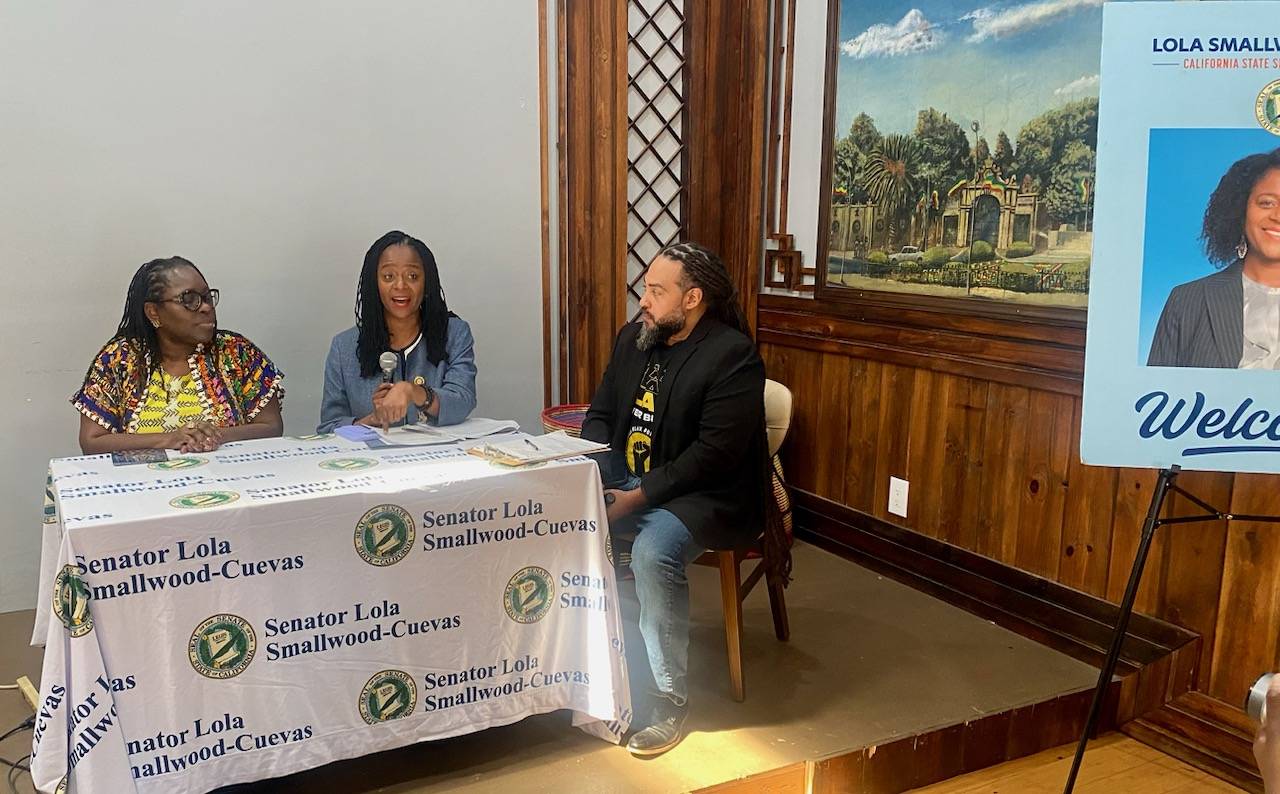


Dr. Nosakhere Thomas, Ph.D., MBA is the Associate Director for the Inland Empire Black Worker Center (IEBWC
San Bernardino, CA — Dr. Nosakhere Thomas told Inland Valley News (IVN) the Inland Empire Black Worker Center (IEBWC) exists to confront what he describes as a longstanding crisis in access to quality employment for Black workers.
“Our mission statement is to build a worker-centered movement that organizes to attain quality jobs, economic and social mobility, and policy change to ensure Black workers, their families and their communities thrive,” Thomas said.
Thomas, who serves as executive director, explained that the organization centers workers in both advocacy and workforce development efforts.
“It’s all about centering the worker for economic advantage, labor advantage, to improve conditions overall for them and their families,” he said.
The IEBWC emerged after research highlighted deep disparities in employment and income across San Bernardino and Riverside counties.
Thomas pointed to a foundational report titled Ain’t No Sunshine, which examined the state of Black workers in the region.
“It’s the state of black workers in the Inland Empire,” Thomas said of the report. The report tracked income levels and unemployment disparities.
“It tracked their economic incomes, the fact that Black folks were often in single to double digit in unemployment in relationship to white counterparts,” he said.
He added that the research also found that “a black woman in San Bernardino County was the poorest.”
The findings led to a key recommendation.
“It recommended that there was a need for a Black center in the Inland Empire,” Thomas said.
Today, the Inland Empire center operates as part of a broader regional network.
“We exist today as part of a cluster of black worker centers in Southern California,” Thomas said.
Thomas frames employment barriers as intersectional, arguing that job access cannot be separated from housing, health or transportation.
“If you don’t have good housing, it’s hard to be a good worker. If you don’t have good mental health, it’s hard to be a good worker. If your physical health is impaired, it’s hard to be a good worker. If you don’t have access to good paying jobs, then it’s hard to be a good worker,” he said.
He traces the roots of what he calls a “Black job crisis” to economic shifts in the late 1960s and 1970s, when industrial plants that had employed many Black union workers downsized or closed.
“We exist because there was a Black job crisis in the late ‘60s through the ‘70s through, you know, the ‘80s, even until now,” Thomas said.
The center works, he said, to address systemic barriers.
“We address this Black jobs crisis in trying to mitigate the structures of discrimination, structures of unequal access, structures of unskilled work, and the structures of bad policy,” he said.
He noted that practical obstacles also play a role.
“Transportation is an issue. Child care can often be an issue,” Thomas said. “We also have sexism as a barrier as well.”
To advance its mission, the organization partners with labor and academic institutions.
Thomas said the center is fiscally sponsored by Congregations Organized for Prophetic Engagement (COPE).
Thomas also serves as a delegate to the Inland Empire Labor Council.
“I sit at the table with I think there are a hundred or so labor unions representing I think about 350,000 workers across the region,” he said.
Those partnerships, he added, provide tangible benefits.
“Those relationships really afford us credibility in the community, influence, resources, collaboration and access,” Thomas said.
In addition to policy advocacy and research, the center offers workforce training programs, including a Worker Rights Ambassador Program, or WRAP, which trains community members on wage theft, discrimination claims and workers’ rights.
The center has also hosted public events combining civic education with cultural programming.
Reflecting on a recent event called “Liberation, Laughter and Line Dance,” Thomas described the organization’s approach.
“What we discovered is that there is so much humiliation, pain and indignities going on right now that we’ve got to give medicine and then a sweet chaser,” he said. “We call it Black joy.”
Thomas’ commitment to labor advocacy is deeply personal.
He spoke about his mother, who moved to Southern California from Louisiana as a single parent of four children and worked as a licensed vocational nurse.
“I saw my mother struggle with the intersections of being Black, being a woman, being poor and being a single parent,” he said.
That experience shaped his sense of purpose.
“It became my calling, my goal, my purpose and my interest to work on behalf of the least, the last, the lucky, the unlucky, and the left out to advocate for them, to support them, and to champion their causes,” Thomas said.
For Thomas, the work ultimately centers on empowerment.
“Just trying to find ways to help people become empowered, to have power, to build power, to have voice, to have agency,” he said.