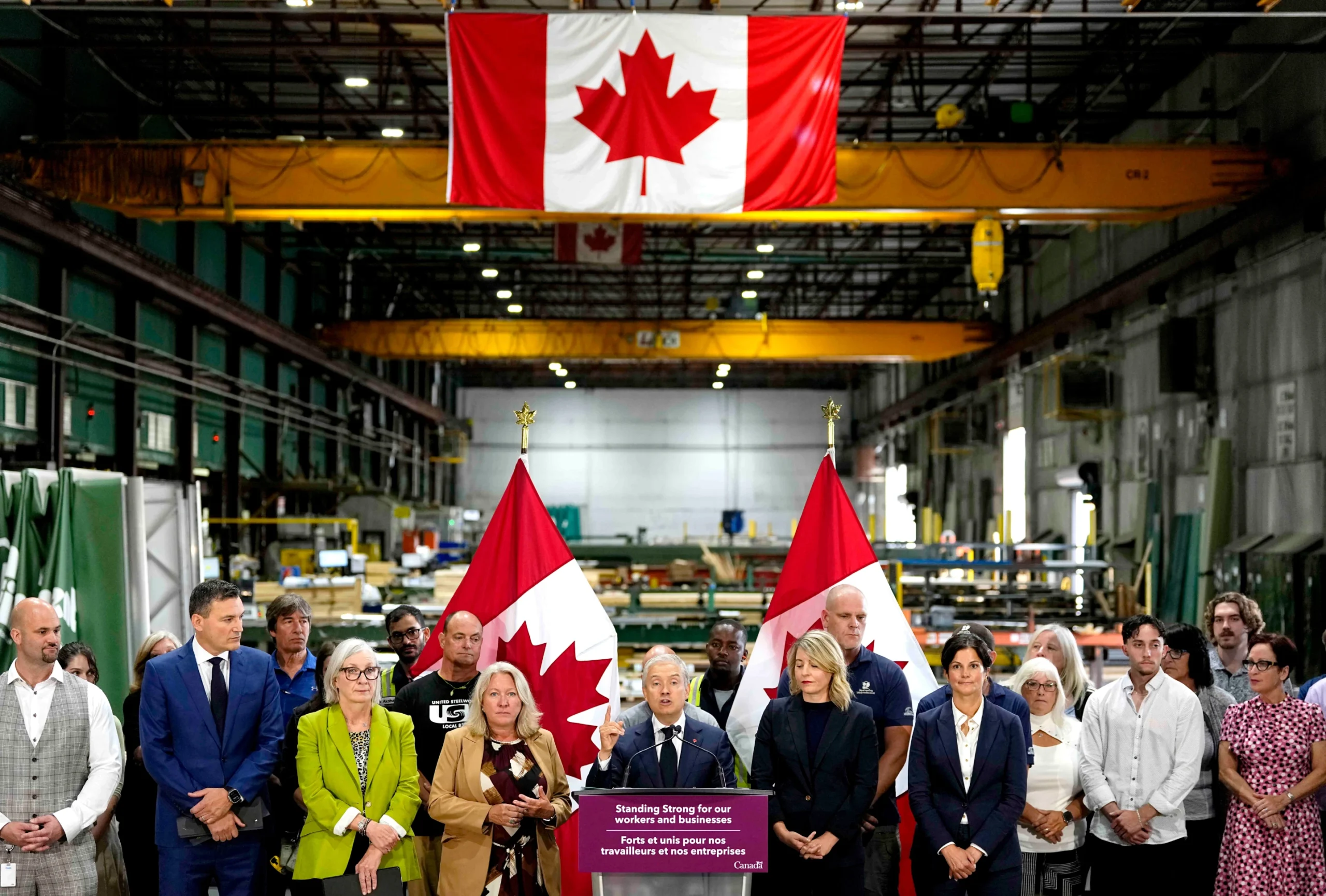
Minister of Finance and National Revenue Francois-Philippe Champagne speaks at a news conference on Canada’s response to U.S. tariffs, at a roofing company in Ottawa, on Tuesday, Aug. 25, 2026. (Justin Tang/The Canadian Press via AP)
Inland Valley – A renewed tariff fight between the United States and Canada could have consequences extending well beyond the two nations’ political capitals, potentially affecting manufacturers, distributors, truckers, retailers and consumers throughout Southern California’s Inland Empire.
Canada began imposing new tariffs Tuesday on C$27.6 billion worth of U.S. goods in retaliation for 50% tariffs the United States placed on a comparable value of Canadian products last month.
The Canadian tariffs range from 15% to 50% and target sectors including steel, dairy, appliances, agricultural equipment, pulp and paper, plastics and electronics.
For Riverside and San Bernardino counties, the dispute matters because the Inland Empire has become one of the country’s largest warehousing and distribution centers and is closely tied to international trade moving through the ports of Los Angeles and Long Beach.
The San Pedro Bay port complex supports an estimated 990,000 jobs across a five-county Southern California region that includes Riverside and San Bernardino counties, according to Port of Los Angeles data.
Goods arriving at the ports routinely move east through Inland Empire highways, rail yards and distribution centers before reaching stores and consumers throughout the country.
That means disruptions or changes in international trade can eventually reach warehouse floors, trucking companies, manufacturers and household budgets across the region.
Tariffs are levies charged on imported goods.
While governments impose them, the cost can ultimately be absorbed by businesses or passed along through the supply chain, potentially affecting what companies pay for raw materials, equipment and finished products.
Canada’s latest countermeasures are aimed primarily at American exporters.
For example, a U.S. manufacturer attempting to sell certain steel products, electronics or appliances in Canada could now face a higher cost at the border. Canadian buyers may respond by purchasing fewer American products or finding alternative suppliers.
Those changes can affect factories, suppliers and distributors in the United States — including California firms that sell into the Canadian market.
At the same time, U.S. tariffs on Canadian products could raise costs for American companies that rely on Canadian inputs.
For Inland Empire businesses operating on thin margins, even relatively small increases in transportation, equipment or material costs can become significant.
The region occupies an unusual position in the national economy.
Riverside and San Bernardino counties are both major consumer markets and major links in the supply chain connecting the ports to the rest of the United States.
Warehouses throughout communities including Ontario, Fontana, Rancho Cucamonga, Rialto and San Bernardino receive enormous volumes of imported merchandise.
Truckers, railroad workers, logistics companies and distribution-center employees depend on consistent freight movement.
Trade uncertainty can change that flow.
The Port of Los Angeles reported that July 2026 loaded imports were down about 8% from July 2025, while loaded exports also fell approximately 8%, although overall calendar-year cargo volume remained slightly higher than the previous year through July.
Port officials have previously described a tariff-driven “whipsaw effect,” with importers accelerating shipments ahead of anticipated tariff increases and then reducing orders afterward.
For the Inland Empire, those fluctuations can translate into changing warehouse demand, trucking schedules and inventory levels.
Canada introduced its latest measures after trade negotiations with the United States broke down in August.
Prime Minister Mark Carney has said Canada plans to accelerate efforts to reduce its dependence on the U.S. economy while remaining open to a mutually beneficial trade agreement.
President Donald Trump has argued that tariffs are necessary to protect American economic interests and has accused Canada of benefiting unfairly from its trade relationship with the United States.
Tensions have expanded beyond the original tariff dispute. Trump this week threatened to block Canadian aircraft manufacturer Bombardier from selling planes in the United States unless the company relocates manufacturing to the country. Bombardier says it employs approximately 3,500 people in the United States and works with thousands of American suppliers.
Canada has also announced billions of dollars in programs intended to support Canadian workers and businesses affected by U.S. tariffs.
The latest tariffs do not mean every product sold in the Inland Empire will suddenly cost 15%, 25% or 50% more.
The effect depends on where a product comes from, whether it is covered by a tariff, how much of the additional cost a company absorbs and whether businesses can shift to other suppliers.
But a prolonged trade dispute can create broader pressures.
Businesses may face higher costs, manufacturers may alter production, exporters may lose customers and companies may delay investments while waiting for trade rules to become clearer.
In an economy as closely connected to goods movement as the Inland Empire, those effects bear watching.
For local families, the key question will eventually be whether the escalating trade dispute begins showing up in prices, jobs and economic activity closer to home.
______
Inland Valley News will continue monitoring the tariff dispute and its effects on Southern California consumers, businesses and the regional logistics economy.