

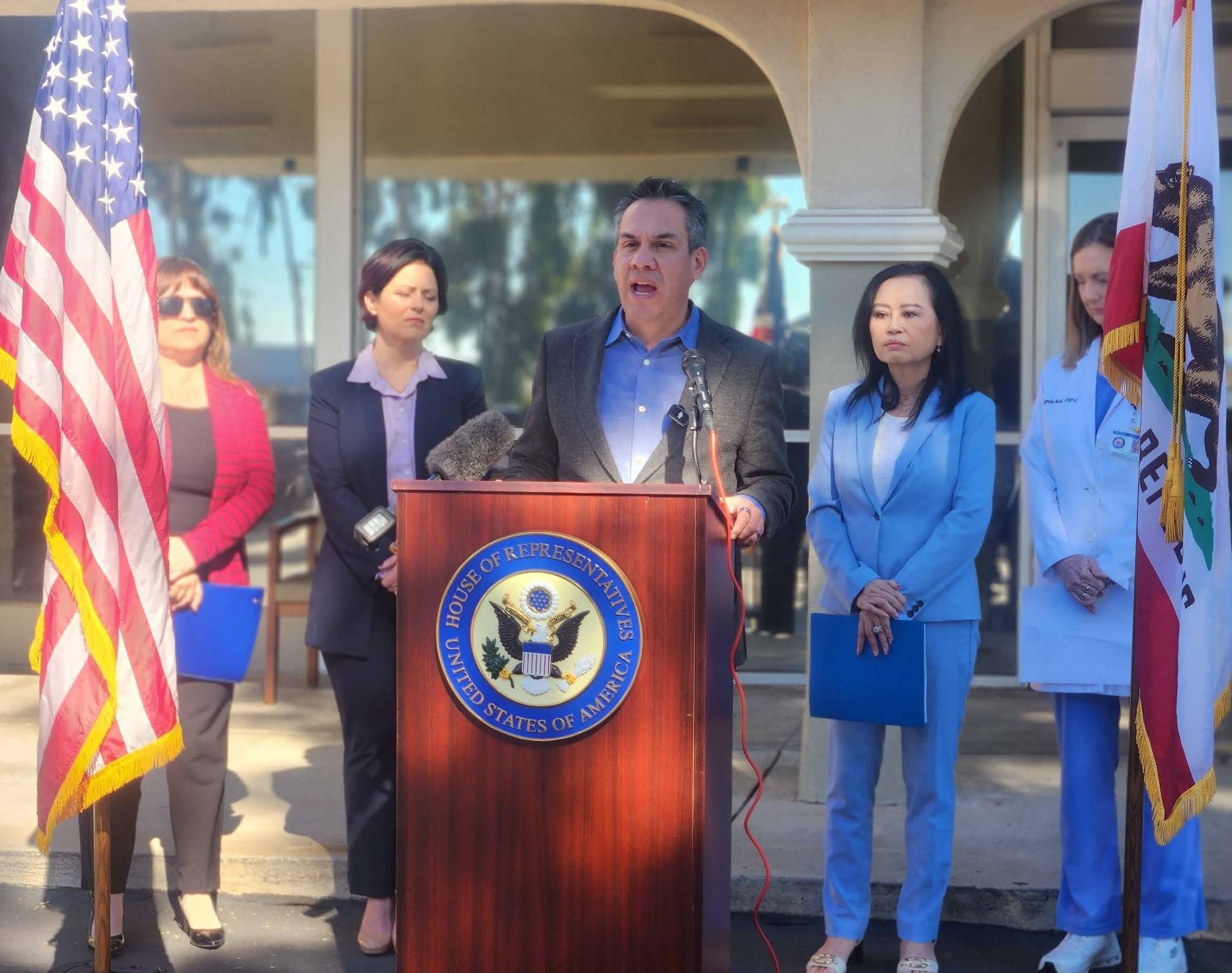
Rep. Pete Aguilar stood alongside health care providers and Inland Empire residents on Jan. 27 at Unicare Community Health Center, San Bernardino, CA. / Photo Credit: Inland Valley News
Rep. Pete Aguilar stood alongside health care providers and Inland Empire residents on Jan. 27 at Unicare Community Health Center, calling on Senate Republicans to restore expired Affordable Care Act premium tax credits that local leaders say are driving up insurance costs across the region.
“Right now, tens of thousands of people in the Inland Empire have seen their monthly insurance premiums skyrocket because Donald Trump and Republicans let the Affordable Care Act tax credits expire at the beginning of January,” Aguilar said.
The enhanced tax credits expired Jan. 1 of this year.
According to information shared at the press conference, new enrollment in Covered California within California’s 33rd Congressional District has declined by 35% compared to last year due to rising costs.
Aguilar said the consequences are already being felt by working families.
“Parents are making tough decisions about whether to buy groceries or pay for doctor visits,” he said. “Seniors are having to decide whether to pay their prescription medications or their utility bills. And young people are having to decide if they need health care at all.”
House Democrats advanced legislation to restore the credits for three years, which Aguilar said would reduce premiums for about 21,000 residents in the 33rd District and more than 1.7 million Californians statewide.
The measure passed the House with bipartisan support and now awaits Senate action.
“What we need now is for Senate Republicans to stop the delay and to act,” Aguilar said. “The American people can’t afford more delays.”
Kelly Vo, executive vice president of Unicare, said the Affordable Care Act has been central to expanding access to care in San Bernardino County.
“At Unicare, the Affordable Care Act has been instrumental in helping our patients access consistent, affordable and high-quality health care,” Vo said . “Thanks to the ACA, many individuals and families in our community can receive the care that they need, regardless of their health condition, without the fear of losing coverage or facing unexpected costs.”
She warned that “with the recent cuts to the ACA, it poses a serious threat to the health coverage and the financial stability of the individuals and families across our community.”
As more residents lose or drop coverage, she said, clinics face increased strain and growing demand for uncompensated care.
Dr. Lynda Reed, Unicare’s quality director, outlined the long-term impact of the ACA locally.
“In San Bernardino County, the uninsured rate was 20% in 2012 and by 2023 down to 8%, largely due to individuals gaining coverage through the Affordable Care Act,” Reed said.
However, she cautioned that “with the loss of subsidies, many individuals will once again be forced to go without coverage, putting their health and financial stability at risk.”
Dr. Camille Carter, a Redlands pediatrician and small business owner, described how rising premiums are affecting both providers and patients.
“I’m a pediatrician, a mom, and a small business owner,” Carter said, explaining she was speaking about “the financial strain our community is under.”
“As a physician, I’m seeing families lose their health insurance, not because they don’t work hard, but because they fall into an impossible gap,” she said.
Maria Ortiz, a part-time faculty member at San Bernardino Valley College and a Covered California enrollee, provided one of the most detailed accounts of how the tax credit expiration has affected working professionals.
“Starting in 2020, I purchased health care coverage through a Covered California health provider,” Ortiz said . “Initially, I was paying about $100 a month.”
As a part-time professor without employer-provided benefits, she said income instability makes it difficult to maintain eligibility for assistance.
“We do not have a promised class each semester. We don’t have a stable salary,” Ortiz said.
She described how her premium recently surged.
“Now my premium went from $202.41 last December to $394.67. It doubled,” she said. “Once that premium is paid, I’m left with $700.”
Ortiz said the burden extends beyond her own household.
“There are hundreds of families,” she said. “Professors and part-time professors don’t have benefits.”
She urged federal leaders to respond quickly.
“They need to act upon this,” Ortiz said.
Aguilar said the debate in Washington is not abstract.
“These aren’t just numbers on a piece of paper from a budget perspective in Congress,” he said. “These are real-life numbers.”
He closed with a direct appeal.
“We have to do better. We need to do better,” Aguilar said . “It’s on Senate Republicans to extend these tax credits for three years.”